

NIFT 2026 Answer Key Challenges has started on 17 February 2026 and the last date to raise objections is 19 February 2026.
NIFT 2026 application form submission closing on 16 January 2026. Candidate can fill application fee with late fee till 17 January 2026.
Two new cities were added for NIFT 2026 Exam. These are Vapi in Gujrat and Daman
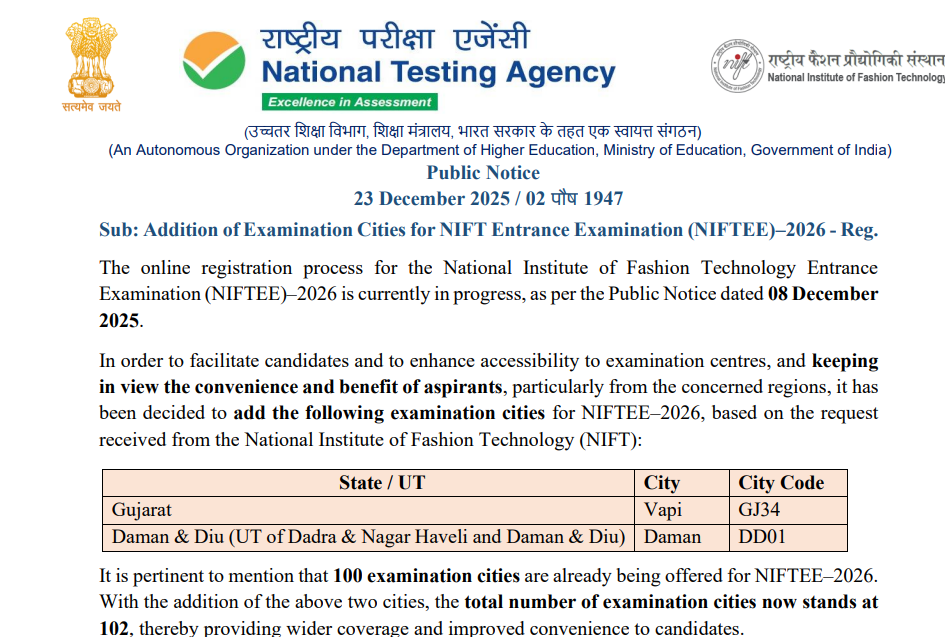
Two newThe NIFT 2026-The application form opened today 8 December and will continure till 6 January 2026
The Entrance Exam (National Institute of Fashion Technology) will be held in February 2026 for admission to undergraduate and postgraduate design programs, such as B.Des, B.F.Tech, M.Des, M.F.Tech, and M.F.M across all NIFT campuses in India.
NIFTs are known for their quality education in India and getting admission here will ensure a job in the market for the students. There are more than 4500 seats available in campus spread across India.
There are stages for admission into the NIFT it starts from appearing online written test, offline creative test and last situational test. The first online test is conducted by NTA and rest two test are done by NIFT
Highlights
| Particulars | Details |
| Conducting Authority | National Testing Agency (NTA) on behalf of NIFT |
| Notification Release | Released in December 2025 |
| Registration Period | 8 December – 6 January 2026 (1st week) |
| With Late of Rs.5000 | 7 to 10 January 2026 |
| Correction Window Opening Date | 12 to 14 January 2026 |
| Admit Card Release | Released |
| Exam Date | 8 February 2026 |
| Result Declaration | March 2026 |
| Studio Test / GD-PI | April–May 2026 |
| Counselling | June–July 2026 |
| Official Website | nift.ac.in / exams.nta.ac.in/NIFT |
Exam Pattern (NIFT 2026)
Stage 1 – Written Tests
- GAT (General Ability Test):
- Mode-online (computer-based)
- Topics- Quantitative Ability, English Comprehension, Analytical Ability, General Knowledge, and Communication Ability
- Timing: 2 hours (B.Des: 100 questions, M.Des: 120 questions)
- CAT (Creative Ability Test):
- offline (pen-paper mode)
- Tests creativity, design sense, color visualization, drawing skills, and originality
- Duration: 3 hours
Stage 2 – Situation Test / Personal Interview
- For B.Des: Situation Test (model making to assess real-world creativity)
- For PG Programs: GD + Personal Interview
Weightage of Different Tests
| Course | GAT | CAT | Interview / Situation Test |
| B.Des | 30% | 50% | 20% |
| M.Des | 30% | 40% | 30% |
| B.F.Tech | 100% GAT | – | – |
| M.F.Tech / M.F.M | 70% GAT | – | 30% |
Eligibility Criteria
- B.Des / B.F.Tech: Must have passed Class 12 from a recognized board, age limit below 24 years on 1st August 2026.
- M.Des / M.F.M / M.F.Tech: Bachelor’s degree (in any discipline for MFM; in design, technology, or engineering for M.Des and M.F.Tech).
Let us check the Admission process right from registration
Registration 2026
Step 1 – Registration and Application Form
- You must apply online at exams.nta.ac.in/NIFT or nift.ac.in.
- You will register using Aadhaar number, valid email ID, and phone number.
- Now fill out details, choose preferred exam city, and upload scanned photograph and signature in JPEG format (max 100 KB).
- Application Fee: INR 3,000 for General/OBC/EWS and INR 1,500 for SC/ST/PwD candidates.
- Payment can be made online via credit/debit card, UPI, or net banking.
2 – Admit Card and Examination
- Admit cards will be out in the first week of February 2026.
- The NIFT written exam will be in two parts for UG/PG design programs:
- CAT (Creative Ability Test): Pen-and-paper exam (3 hours) for creativity and design visualization.
- GAT (General Ability Test): Computer-based test for English comprehension, quantitative and analytical ability, and general awareness.
- For B.F.Tech, only the GAT exam is required.
3 – Result and Shortlisting
- The expected dates for written exam result are in March 2026.
- Candidates shortlisted based on CAT and GAT scores will proceed to the Situation Test (for B.Des) or Group Discussion/Personal Interview (for PG courses).
- 4 – Situation Test / GD-PI
- B.Des: A hands-on “Situation Test” evaluates creativity, innovation, and material handling.
- M.Des, M.F.Tech, M.F.M: Candidates attend a Group Discussion (GD) focusing on communication, leadership, and presentation skills, followed by a Personal Interview (PI) assessing aptitude and motivation.
- Weightage breakdown for final selection:
Weightage Breakdown
| Program | GAT | CAT | Situation Test / GD/PI |
| B.Des | 30% | 50% | 20% |
| M.Des | 30% | 40% | 30% |
| B.F.Tech | 100% GAT | – | – |
| M.F.Tech / M.F.M | 70% GAT | – | 30% |
Step 5 – Final Merit List
- The final merit list is prepared based on the combined performance in written exams and subsequent tests.
- Results will be published online with the Common Merit Rank (CMR) for each candidate.
6 – Counselling and Seat Allotment
- Online e-counselling begins in June–July 2026 for all 19 NIFT campuses.
- Candidates must:
- Register for counselling and pay INR 9,300 as registration fee.
- Upload required documents and fill preference choices of course and campus.
- Pay seat acceptance fee (around INR 1,83,200) once allotted a seat.
- Seat allotment occurs in three regular rounds followed by a SPOT round for vacant seats.
7 – Final Admission
- After seat allocation, candidates must physically report to their allotted NIFT campus with all original documents for verification and payment of remaining fees.
- Once verified, admission is officially confirmed and classes generally begin in August 2026.
Thus, the NIFT admission process — from registration to campus joining — spans approximately November 2025 to August 2026.
Application form Date
The NIFT 2026 Application Form as in the past trend application form will open n the last week of November 2025, and candidates can apply online through exams.nta.ac.in/NIFT or nift.ac.in.
NIFT 2026 Application Schedule
| Event | Tentative Dates |
| Application form release | Last week of November 2025 |
| Last date to apply (without late fee) | First week of January 2026 |
| Application with late fee | Second week of January 2026 (late fee: ₹5,000 extra) |
| Application correction window | Second week of January 2026 |
Application Fee (as per category)
| Category | Regular Fee | With Late Fee |
| General / OBC (Non-Creamy Layer) / GEN-EWS | ₹3,000 | ₹8,000 (₹3,000 + ₹5,000) |
| SC / ST / PwD | ₹1,500 | ₹6,500 (₹1,500 + ₹5,000) |
Mode of Payment
- Payment can be made online via debit/credit card, UPI, or net banking.
- Candidates registering late must pay the late fee online during the extended window.
Document Requirements
While filling out the form, candidates will need:
- A recent passport-size photograph (JPEG, max 100 KB)
- A signature in blue/black ink (JPEG, max 100 KB)
In short, NIFT 2026 registration begins in late November 2025, remains open until early January 2026, and the fee is ₹3,000 for general candidates and ₹1,500 for SC/ST/PwD, with a possible ₹5,000 late fee for delayed submission.
Rank
Admission to NIFT campuses is based on a rank-wise cutoff issued by the National Institute of Fashion Technology (NIFT) after each round of counselling. The cutoff is not the same for all campuses it varies by campus, course, and category and is expressed as the Common Merit Rank (CMR).
NIFT 2025–26 Expected Cutoff (General Category)
| Campus | Course | Expected Opening Rank | Expected Closing Rank |
| NIFT Delhi | B.Des (Fashion Design) | 1 | 110 |
| NIFT Mumbai | B.Des (Fashion Design) | 111 | 200 |
| NIFT Bengaluru | B.Des (Fashion Design) | 201 | 350 |
| NIFT Hyderabad | B.Des (Fashion Design) | 351 | 700 |
| NIFT Kolkata | B.Des (Fashion Communication) | 210 | 400 |
| NIFT Chennai | B.Des (Accessory Design) | 300 | 900 |
| NIFT Gandhinagar | B.Des (Textile Design) | 380 | 1200 |
| NIFT Patna | B.Des (Fashion Design) | 701 | 1500 |
| NIFT Kannur | B.Des (Fashion Design) | 594 | 1416 |
For top campuses such as Delhi, Mumbai, and Bengaluru, students typically need to rank within the top 100–300 for B.Des admission and within top 500 for B.F.Tech programs.
Category-Wise Typical Closing Ranks (B.Des, Fashion Design)
| Category | Approximate Rank Range | Notes |
| General | 1–1500 | Very competitive, especially in top 5 campuses |
| OBC-NCL | 400–2500 | Moderate advantage in cutoffs |
| SC | 900–3500 | Relatively lower cutoff |
| ST | 1500–4500 | Lowest qualifying rank range |
NIFT Marks vs Rank (Expected 2026)
Based on past data and exam difficulty trends :
| Marks (out of 100) | Estimated Rank Range | Admission Chances |
| 75–85+ | 1–100 | Excellent – Top 3 campuses |
| 65–75 | 101–500 | Very good – Delhi, Mumbai, Bengaluru possible |
| 55–65 | 501–1000 | Mid-tier campuses (Chennai, Kolkata, Hyderabad) |
| 45–55 | 1001–2000 | Lower-tier campuses (Patna, Raebareli, Kangra) |
Key Points
- The cutoff is released round-wise after each counselling phase on the official site nift.admissions.nic.in under the OR-CR (Opening–Closing Rank) section.
- Higher competition and fewer seats in design courses (like Fashion Communication or Accessory Design) result in lower closing ranks.
- Reserved category students have relatively relaxed cutoffs but must still meet portfolio and interview standards.
You must try for a rank 250 to 300 generally ensures a seat in a top NIFT campus, while ranks up to 2000–2500 can secure admission in newer or regional NIFTs, depending on the course and category.
Exam Pattern (Overview)
| Exam Component | Mode | Type of Paper | Duration | Applicable Courses |
| CAT (Creative Ability Test) | Offline | Drawing/Descriptive | 3 hours | B.Des, M.Des |
| GAT (General Ability Test) | Online (CBT) | Objective (MCQs) | 2–3 hours | All Courses (B.Des, B.F.Tech, M.Des, M.F.Tech, M.F.M) |
| Situation Test | Offline | Hands-on (Model making) | 2 hours | B.Des only |
| GD/PI | Offline | Interview / Group activity | 15–20 min | PG programs |
Marking Scheme: 1 mark for each correct answer, no negative marking in GAT.
GAT Syllabus (for All Courses)
The GAT assesses aptitude, reasoning, and general awareness through multiple sections :
| Section | Concepts Covered |
| Quantitative Ability | Arithmetic (fractions, percentages, ratios, time, work, distance) |
| Communication and English Comprehension | Vocabulary, grammar, synonyms/antonyms, idioms, comprehension |
| Analytical and Logical Ability | Puzzles, analogies, pattern recognition, series completion |
| General Knowledge and Current Affairs | Recent events, fashion industry updates, politics, economy |
| Case Study (for PG programs) | Business and management-related decision-making |
Question Pattern:
- B.Des: 100 questions (120 mins)
- M.Des: 120 questions (120 mins)
- B.F.Tech, M.F.Tech, M.F.M: 150 questions (180 mins).
CAT Syllabus (for Design Courses)
The CAT measures creativity, innovation, and design potential :
- Visualizing and illustrating concepts
- Understanding color harmony, composition, and proportion
- Expression through sketches and design elements
- Observation, innovation, and original ideation
The candidates attempt 3 descriptive drawing questions requiring concept sketches and design interpretation.
Situation Test and Interview Phase
- B.Des: Students build 3D models using provided materials within 2 hours, accompanied by a brief written explanation of the concept.
- PG Courses: Group Discussion and Personal Interview assess problem-solving, awareness, leadership, and presentation skills.
For NIFT 2025–26, there are a total of 4,837 seats across all 19 NIFT campuses in India, covering both undergraduate (UG) and postgraduate (PG) programs.
Course-Wise Seat Distribution (NIFT 2025)
| Programme | Total Seats |
| B.Des (Accessory Design) | 596 |
| B.Des (Fashion Communication) | 719 |
| B.Des (Fashion Design) | 719 |
| B.Des (Fashion Interior) | 41 |
| B.Des (Knitwear Design) | 310 |
| B.Des (Leather Design) | 152 |
| B.Des (Textile Design) | 681 |
| B.F.Tech (Apparel Production) | 591 |
| M.Des (Master of Design) | 275 |
| M.F.M (Master of Fashion Management) | 719 |
| M.F.Tech (Master of Fashion Technology) | 34 |
| Total | 4,837 |
Campus-Wise Approximate Seat Matrix (Regular Category)
| NIFT Campus | Total Seats (UG + PG) |
| NIFT Delhi | 588 |
| NIFT Mumbai | 558 |
| NIFT Bengaluru | 564 |
| NIFT Kolkata | 534 |
| NIFT Chennai | 486 |
| NIFT Hyderabad | 360 |
| NIFT Gandhinagar | 516 |
| NIFT Patna | 342 |
| NIFT Kangra | 306 |
| NIFT Kannur | 306 |
| NIFT Jodhpur | 306 |
| NIFT Bhopal | 180 |
| NIFT Shillong | 180 |
| NIFT Raebareli | 180 |
| NIFT Bhubaneswar | 180 |
| NIFT Daman | 180 |
| NIFT Panchkula | 180 |
| NIFT Varanasi | 180 |
| NIFT Srinagar | 180 |
NRI and Supernumerary Seats
- 5 NRI seats per programme are available at major campuses — Delhi, Mumbai, Chennai, Bengaluru, Gandhinagar, Hyderabad, Kolkata, and Raebareli.
- 3 NRI seats per programme at other campuses like Bhopal, Kangra, Kannur, and Shillong.
Lateral Entry Seats
There are 796 Seats for Lateral Entry