
CLAT 2026 Exam Pattern: Syllabus, Sections, Marks, and Question Format
It is important to know the CLAT 2027 syllabus for the students to prepare for CLAT 2027 as is saying start early. The exam will be taking place in December first Sunday. You have ample time to prepare for CLAT 2027.
Checking the clat syllabus is always important point. It is first step towards your preparation. You must also remember that NLUs admission takes 90 plus score. Though local criteria has advantage but you should not expect much difference in asking percentage.
Check the CLAT 2027 full syllabus
UG-CLAT 2027 is designed to test a candidate’s comprehension, reasoning, and aptitude for legal education. It does not require prior legal knowledge in most sections, although awareness of current affairs and general knowledge can be helpful in some questions.
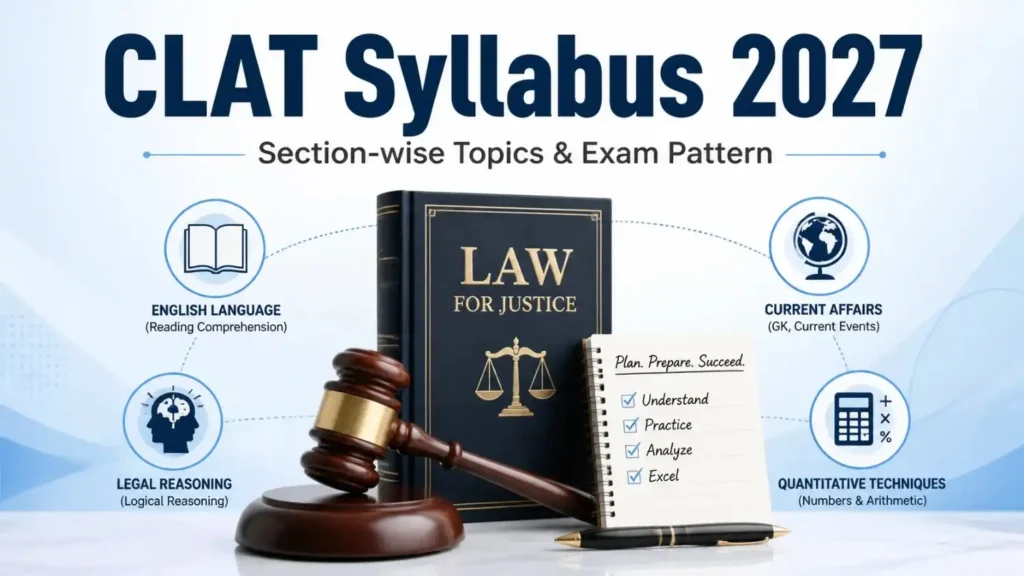
The exam will be a 2-hour test with 120 multiple-choice questions, each carrying 1 mark. For every wrong answer, 0.25 marks will be penalty. The paper divided into 5 sections: English Language, Current Affairs including General Knowledge, Legal Reasoning, Logical Reasoning, and Quantitative Techniques.
English Language
In this section, candidates will read passages of about 450 words each. These passages may come from fiction or non-fiction texts of contemporary or historical importance, written at a level that a Class 12 student can read in about 5–7 minutes.
Questions in this section test the ability to:
- Understand the main idea of the passage.
- Identify arguments and viewpoints.
- Draw inferences and conclusions.
- Summarize the passage.
- Compare different arguments or perspectives.
- Understand the meaning of words and phrases in context.
Current Affairs Including General Knowledge for CLAT 2027
This section also includes passages of up to 450 words each, taken from news reports, journalistic writing, and other non-fiction sources. Some questions may touch on legal information related to the passage, but no extra legal knowledge beyond the passage is required.
This section checks awareness of:
- Important current events in India and the world.
- Arts and culture.
- International affairs.
- Historical events of continuing significance.
Legal Reasoning
This section uses passages of around 450 words based on legal issues, public policy, or moral and philosophical questions. No prior legal knowledge is required, but a general awareness of current legal and moral issues may help.
Questions in this section test the ability to:
- Identify rules and principles in the passage.
- Apply those principles to different fact situations.
- Understand how changes in rules affect outcomes.
CLAT 2027 Logical Reasoning
The Logical Reasoning section includes short passages of about 450 words. Each passage is followed by one or more questions that assess analytical and reasoning skills.
Candidates are expected to:
- Recognize arguments, premises, and conclusions.
- Analyze reasoning patterns.
- Judge how conclusions change if premises change.
- Infer what follows from the passage.
- Identify analogies, contradictions, and equivalence.
Quantitative Techniques
This section includes short sets of numerical facts, propositions, or text-based data. Candidates must extract and use the information to solve questions.
The questions require:
- Deriving and manipulating numerical information.
- Applying Class 10-level mathematics.
- Working with ratios, proportions, basic algebra, mensuration, and statistical estimation.
Expert Advice
UG-CLAT 2027 preparation should focus on the official learning platform, model papers, online expert sessions, and daily reading practice across all five sections. The preparation guidance also emphasizes reading quality newspapers and periodicals for Current Affairs, plus Class 10-level mathematics practice for Quantitative Techniques.
CLAT 2027 PYQs
It is always better to check the previous year’s question papers which helps candidate to understand the question pattern asked in the exam.
CLAT 2027 Applicaiton form and Eligibility
The CLAT 2027 application form generally opens in the last week of July or first week of August every. It offers the integrated Law course for this the candidates should be 10+2 pass-outs from any stream with 45 percent marks in last qualifying exam
Is there any preparation formula for CLAT 2027?
The best formula to prepare for CLAT 2027 is to start early for CLAT 2027 preparation. Knowing the syllabus of the CLAT 2027 another important thing
FAQs CLAT 2027 Syllabus
What are the main sections in CLAT 2027?
CLAT 2027 is divided into English Language, Current Affairs including GK, Legal Reasoning, Logical Reasoning, and Quantitative Techniques.
What is in the English Language section?
This section checks reading comprehension, inference, central idea, tone, theme, vocabulary, idioms, paraphrasing, and summarizing skills.
What topics are important in Logical Reasoning?
Key topics include assumption and conclusion, strengthen and weaken, inference, cause and effect, and flaw in reasoning.
What should I study for Quantitative Techniques?
You should focus on percentage, ratio, average, profit and loss, discount, time and work, time speed distance, DI caselets, and basic arithmetic.
What is in Legal Reasoning?
Legal Reasoning includes constitutional law, fundamental rights, Article 14, 19, and 21, contracts, torts, criminal law basics, writs, and legal current affairs
What should be the time frame for the Current Affairs Including General Knowledge section?
There is no specific time frame for the Current Affairs Including General Knowledge section of the Under Graduate CLAT 2026. For more details and clarity on this section, please visit /clat-2026/ug-syllabus.html
Which high-priority legal themes should CLAT aspirants track?
Important themes include freedom of speech vs obscenity, right to privacy vs public interest, electoral bonds, political funding, BNS–BNSS changes, reservations, affirmative action, and AI and law.
Is there any order in which I should prepare for CLAT sections?
A practical order is Current Affairs and GK first, then Legal Reasoning, followed by English Language, Logical Reasoning, and Quantitative Techniques
Why is current affairs important for CLAT?
Current affairs are important because the exam includes passages based on news, public policy, legal issues, and world events, which need strong awareness and reading speed.