
BSc LLB Course (Bachelor of Science + Bachelor of Laws) is a 5-year integrated law degree that combines science subjects with legal studies. It is approved by the Bar Council of India (BCI) and prepares students for careers in legal practice, intellectual property, environmental law, forensic law, cyber law, and related fields.
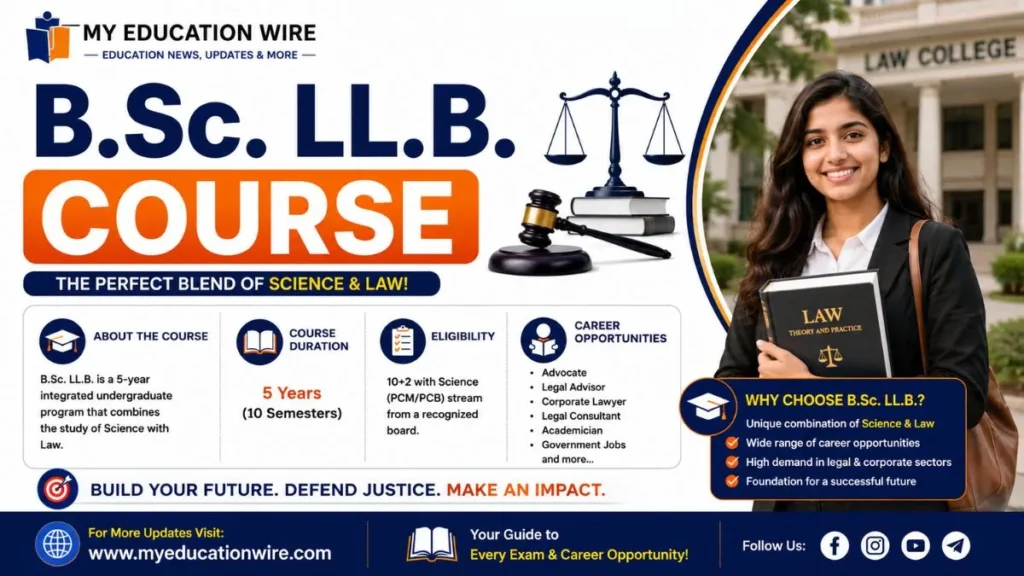
Table of Contents
Can Only Science Students Pursue BSc LLB Course?
Generally, yes. Most universities require candidates to have completed 10+2 with Science (PCM or PCB). However, eligibility criteria vary by institution, and a few universities may admit students from other streams. Therefore, candidates should always verify the specific requirements of the university they are applying to.
BSc LLB Course Highlights
| Particular | Details |
|---|---|
| Course Name | BSc LLB |
| Full Form | Bachelor of Science + Bachelor of Laws |
| Course Type | Integrated Undergraduate Degree |
| Duration | 5 Years (10 Semesters) |
| Mode | Regular |
| Approval | Bar Council of India (BCI) |
| Eligibility | 10+2 with Science stream (PCM/PCB) in most colleges |
| Admission | CLAT, AILET, LSAT, MH CET Law, CUET, University Exams |
| Average Fees | Rs.50,000 – Rs.19 lakh per year |
| Higher Studies | LL.M., MBA, MPP, Ph.D. |
Also Read: UPSIFS BSc LLB Admission 2026
BSc LLB Course Eligibility Criteria
The colleges ask for the science subject in your 10+2 exam. The subjects could be PCM or PCB. Some college may ask for minimum percentage you should have in 10+2 it could be 45 percent to 50 percent.
Subjects Covered
Science Subjects
- Physics
- Chemistry
- Biology
- Environmental Science
- Forensic Science (in some universities)
Law Subjects
- Constitutional Law
- Law of Contracts
- Criminal Law
- Family Law
- Property Law
- Administrative Law
- Company Law
- Intellectual Property Rights
- Cyber Law
- Environmental Law
- Jurisprudence
- Human Rights Law
Admission Process
Candidates are admitted through:
- CLAT
- LSAT-India (where accepted)
- MH CET Law
- CUET
- University-specific entrance exams
Top Universities
- NLU Kolkata
- GNLU Gandhinagar
- NLU Bhopal
- JECRC University
- NFSU
- KIIT School of Law
- MS RUAS cybersecurity
- Admas University
- Uttar Pradesh State Institute of Forensic Science, Lucknow, India
- GH Raisoni MP
- Bhagwant University Rajasthan
- Mahatma Jyoti Rao Phule University Jaipur
- OPJS University Rajasthan
Top Colleges Offering BSc LLB Course
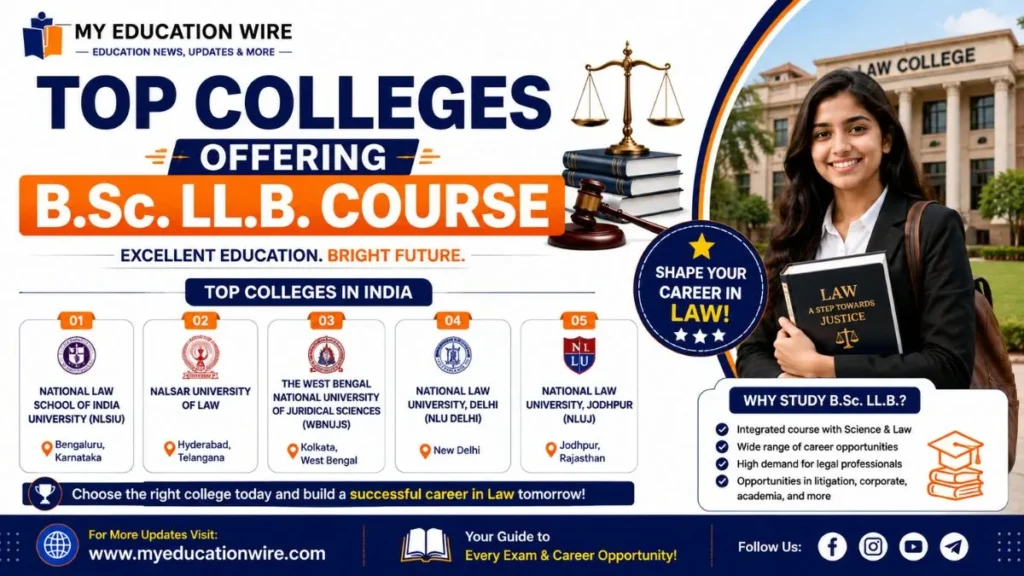
| College | Entrance Exam |
|---|---|
| National Law Institute University (NLIU), Bhopal | CLAT |
| West Bengal National University of Juridical Sciences (WBNUJS), Kolkata | CLAT |
| Gujarat National Law University (GNLU), Gandhinagar | CLAT |
| Some private law universities | CLAT/University Tests |
Also read other: 3 Year LLB Course
Career Opportunities
After BSc LLB Course, graduates can work as:
- Advocate
- Legal Advisor
- Corporate Lawyer
- Patent Attorney
- Cyber Law Specialist
- Intellectual Property Lawyer
- Environmental Lawyer
- Judicial Services Aspirant
- Compliance Officer
- Legal Researcher
Salary
| Experience | Average Annual Salary |
|---|---|
| Freshers | ₹4–8 LPA |
| 3–5 Years | ₹8–15 LPA |
| Top Corporate Firms/IPR Firms | ₹15–30 LPA+ |
FAQs
Q1. Is BSc LLB better than BA LLB?
B.Sc. LL.B. is preferable for students interested in science-related legal fields such as patents, biotechnology, environmental law, and forensic law. B.A. LL.B. is more popular and broadly focused.
Q2. Can a Commerce or Arts student join B.Sc. LL.B.?
Usually no, as most institutions require a Science background in Class 12. Some universities may have different criteria, so check individual admission rules.
Q3. Can B.Sc. LL.B. graduates practice in court?
Yes. After completing the degree and qualifying the All India Bar Examination (AIBE), graduates can enroll as advocates and practice law.
Q4. Is B.Sc. LL.B. available through distance education?
No. BCI recognizes only regular mode integrated law programs for legal practice.
Q5. Which entrance exam is best for B.Sc. LL.B. admission?
CLAT is the most widely accepted entrance exam for admission to premier National Law Universities.