
LLB course has changes over the year ever since UG LLB or Integrated LLB has come into the scene. Now you have many choices of pursuing Integrated LLB e.g., BA LLB, BCom LLB, BSc LLB and BLS LLB. Candidates can choose after 12 which law course they want to pursue as there are choices in Integrated Law courses. The commerce enjoys most the financial terms so they have now choices for pursuing the BCom LLB Course 2026.
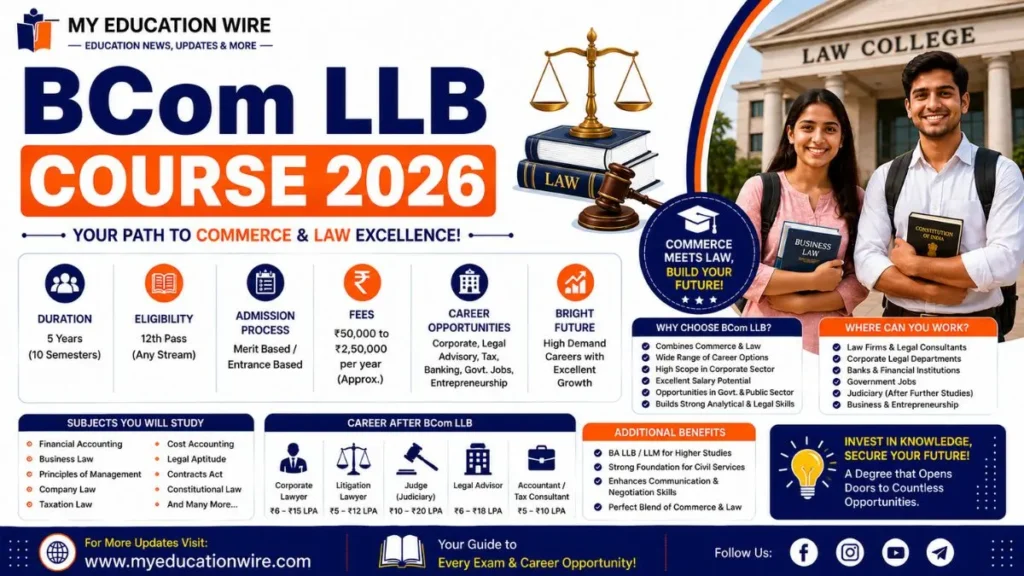
Table of Contents
Modern businesses operate in a highly regulated environment where financial decisions and legal obligations are deeply interconnected. A major corporate acquisition, for example, requires not only sound financial planning and accounting expertise but also meticulous legal drafting, regulatory compliance, and risk assessment. Success in such situations depends on professionals who understand both sides of the equation.
What is a B.Com LLB?
Is it entirely different term in Law. The BCom LLB Course 2026 is a five-year integrated dual-degree program offered by universities across various jurisdictions, most notably in India, South Africa, and parts of the Commonwealth. Candidates, instead of pursuing three years commerce degree and another three years in a traditional law program (totalling six years), can complete the coursework in five years.
Students don’t just study one subject after another; they learn them concurrently. A typical semester balances foundational business subjects with core legal frameworks:
Commerce & Finance
- Financial Accounting
- Auditing
- Corporate Economics
- Business Statistics
- Operational Management
Law
- Law of Contracts
- Constitutional Law
- Criminal Law
- Family Law
- Jurisprudence
- International Law
The Intersection
- Corporate Law
- Taxation Law
- Competition Law
- Banking & Insurance Law
- Intellectual Property Rights (IPR)
The Strategic Advantage: Why Commerce and Law?
Many students wonder whether they should choose a BCom LLB Course 2026 (Arts + Law), a B.B.A. LLB (Management + Law), or a B.Com LLB. While every integrated law degree has its merits, the commerce variant offers a distinct, data-driven edge.
1. Financial Literacy is a Lawyer’s Superpower
A traditional lawyer can read a statute perfectly, but they might struggle to interpret a corporate balance sheet, a cash flow statement, or a forensic audit report. A B.Com LLB graduate can do both. Whether you are dealing with a complex corporate fraud case, asset distribution during a bankruptcy liquidation, or evaluating damages in a breach of contract suit, knowing how money flows gives you an immediate advantage.
2. The Rise of the Regulated Economy
Governments worldwide are continuously updating corporate compliance, data privacy, taxation, and anti-money laundering laws. Startups and multinational conglomerates alike are under constant regulatory scrutiny. Because B.Com LLB graduates understand the economic rationale behind these regulations, they don’t just tell a business what the law says; they help strategize how the business can grow profitably while remaining fully compliant.
3. Time and Financial Efficiency
By combining two comprehensive degrees into a five-year structure, students save a full academic year. This means entering the workforce a year earlier, saving a year’s worth of tuition fees, and gaining a head start on building professional seniority.
Diverse Career Trajectories
The beauty of this dual degree is that it opens doors to multiple distinct career tracks. You are never boxed into a single professional identity.
| Career Path | Primary Responsibility | Ideal For Students Who Love |
|---|---|---|
| Corporate Litigator | Representing businesses in corporate courts, tribunals, and national company law boards. | Debating, problem-solving, and courtroom strategy. |
| Transactional Attorney | Drafting mergers, acquisitions, venture capital investments, and joint venture agreements. | Structuring business deals and handling intense negotiations. |
| In-House Legal Counsel | Serving as the dedicated legal department for a specific company (e.g., tech startups, banks, manufacturing firms). | Managing corporate risk, employment laws, and vendor contracts. |
| Taxation Specialist | Navigating complex corporate tax laws, customs, and international trade tariffs. | Analytical problem solving, numbers, and regulatory frameworks. |
| Compliance Officer | Ensuring a company complies with external regulatory requirements and internal policies. | Governance, ethics, risk management, and structured policy building. |
Beyond these traditional avenues, many graduates leverage their business acumen to pursue entrepreneurial ventures, management consulting, investment banking, or specialized civil services.
Core Skills You Will Master
A BCom LLB Course 2026 is demanding, but the skill set it builds is highly valuable and resilient against changing job markets:
- Analytical & Analytical Reasoning: Breaking down dense legal text alongside complex financial data to find risks or opportunities.
- Drafting and Negotiation: Learning to write clear, unambiguous business contracts, non-disclosure agreements (NDAs), and legal notices where a single misplaced word can cost millions.
- Commercial Awareness: Developing a deep instinct for how markets, inflation, interest rates, and trade policies affect daily business operations.
- Persuasive Communication: Articulating complex business-legal issues clearly, whether pitching a strategy to an internal board or presenting an argument to a judge.
Is BCom LLB Course 2026 Right For You?
While the career rewards are substantial, this path requires a specific mindset. It is an intensive program with a heavy academic workload. You will routinely face semesters packed with case law readings, financial accounting problems, moot court preparations, and research papers.
This degree is an excellent fit if you enjoy keeping up with economic news, like analyzing rules and regulations, and prefer logical, numbers-driven problem solving over purely abstract or theoretical studies.
Final Thoughts on BCom LLB Course 2026
The modern economy rewards professionals who can bridge different disciplines. A specialist who only understands finance must consult a lawyer; a lawyer who only understands code books must consult an accountant.
By holding a B.Com LLB, you position yourself as a unified solution. You become an asset capable of analyzing a balance sheet with an accountant’s precision, while simultaneously protecting the company with a lawyer’s foresight. In a competitive job market, that dual capability is an incredibly strong foundation for a career.
BCom LLB Course 2026 Eligibility Criteria
Does candidate need to have commerce in 10+2 to pursue the BCom LLB. You can check the eligibility criteria to pursue BCom LLB Course 2026.
| Criteria | Requirement |
|---|---|
| Educational Qualification | Must have passed Class 12 (10+2) or an equivalent examination from a recognized board. |
| Minimum Marks | Usually 45%–50% aggregate marks for General category candidates. Relaxation of 5%–10% is often provided to SC/ST/PwD candidates. |
| Stream Requirement | Students from any stream (Commerce, Science, or Arts/Humanities) are generally eligible, although Commerce students may find some subjects more familiar. |
| Age Limit | Most universities currently do not prescribe an upper age limit, subject to the rules of the respective institution and regulatory authorities. |
| Entrance Examination | Admission is commonly based on entrance exams such as CLAT, AILET Exam 2027, SLAT, LSAT—India (when conducted), or university-specific entrance tests. Some colleges also offer admission based on Class 12 merit. |
Syllabus Breakdown: Numbers vs. Strategy
B.Com LLB Syllabus Focus (The Quantitative Track)
This stream explores the mechanics of commerce, focusing heavily on accounting, math, and structured financial systems.
- Key Non-Law Modules: Advanced Financial Accounting, Cost Accounting, Auditing, Business Mathematics & Statistics, Micro/Macroeconomics.
- Legal Specialization Alignment: Heavily emphasizes Tax Laws, Banking and Insurance Regulations, Bankruptcy/Insolvency Code, and Securities/Stock Market Law.
BCom LLB Course 2026 Semester wise subject
| Year | Semester / Area | Subjects |
|---|---|---|
| BA LLB 1st Year | Foundation & Introduction to Law | Legal Method, Sociology, History, Political Science, Economics, English, Introduction to Law, Law of Tort-I, Jurisprudence |
| BA LLB 2nd Year | Core Law Subjects | Laws of Contract, Criminal Law, Constitutional Law, Law of Contract-II, Family Law-I, Constitutional Law-II, Family Law-II, Property Law, Labour Law-I, Environmental Law |
| BA LLB 3rd Year | Advanced Legal Studies | Criminal Laws, Corporate Laws, Administrative Law, Jurisprudence, Public International Law, Law of Evidence, Conflict Laws, Company Laws, Human Rights, Intellectual Property Law, Code of Civil Procedure |
| BA LLB 4th Year | Specialized & Professional Laws | Taxation Laws, Labour Laws, Environmental Laws, Drafting, Pleading and Conveyancing, Intellectual Property Rights, Professional Ethics |
| BA LLB 5th Year | Advanced Practice & Research | Private International Law, Competition Laws, Law of Equity, Trusts and Fiduciary Relations, International Trade Law, Moot Courts, Internships, Research Component |
Year-wise Overview
| Year | Focus Area |
|---|---|
| 1st Year | Development of social science foundations and introduction to legal concepts. |
| 2nd Year | Study of major substantive laws such as Contract, Constitutional, Criminal, Family, Property, and Labour Laws. |
| 3rd Year | Advanced legal subjects including Corporate Law, Evidence, Human Rights, International Law, and Civil Procedure. |
| 4th Year | Professional legal training with Taxation, Drafting, Ethics, Labour, and Environmental Laws. |
| 5th Year | Practical legal education through Moot Courts, Internships, Research Work, and specialized laws such as Competition and International Trade Law. |
BCom LLB Semester Wise Subjects
| Year | Subjects |
|---|---|
| First Year | Business Accounting, Microeconomics, Legal Methods, Constitutional Law, English Communication Skills |
| Second Year | Corporate Accounting, Macroeconomics, Law of Contracts, Family Law, Business Communication |
| Third Year | Business Law, Auditing, Property Law, Taxation Laws, Administrative Law |
| Fourth Year | Corporate Law, Banking and Finance, Criminal Law, Intellectual Property Rights, Environmental Law |
| Fifth Year | Labour Law, International Trade Law, Arbitration and Conciliation, Specialization Electives, Moot Courts, Internship |
Colleges, Admission and fees
| College | Entrance Accepted | Location | Fees |
|---|---|---|---|
| Llyod College | CLAT, AILET, MHCET, BHU, GGIPS, Jamia, AMU | Greater Noida | 5,68,000 total fee |
| GN group of Institution | Through Merit | Greater Noida | 3,00,000 estimated |
| IMS Noida | Through Merit | Noida | |
| IIMT Group of Institution | Through Merit | Greater Noida | 3,72,500 |
| Teeranthakar Mahaveer University | Clat/ Merit Based | Muradabad | 1,37,500 |
| Parul University | Merit | Vadodara Gujrat | 125000 PA |
| Jindal Global Law School | LNAT UK based test | Haryana Sonipat | |
| Invertis University | Merit | Bareilly | 2,50,000 total fee |
| Dev Bhoomi Uttarakhand University | Merit | Dehradun | 3,00,000 total tee |
| CGC University Mohali | CGC UET | Mohali | 3,40,000 total fee |
| RIMT University | Merit Based | 3,75,000 total fee | |
| Symbiosis Law School | SLAT | Pune | 5,,06,000 per annum |
| Amity University | Merit/CLAT | Gurugram | 9,00,000 total fee |
| Cochin University of Science and Technology | CUSAT | Kerala | 98,710 total fee |
| NIRMA University | CLAT score | Kerala | 4,25,700 per annum |
| Chandigarh University | CUCET own test | Gujrat | 2,00,000 Per annum |
| Bharat Mata School of Legal Studies | KLEE | Kerala | 5,10,000 total fee |
| Karnataka State Law University | Its own entrance test | Hubballi | 35,000 |
| Dr. MGR Educational and Research Institute(Vistas) | Merit Based | Tamil Nadu | 1,95,000 per year |
Frequently Asked Questions (FAQs)
1. What is B.Com LLB?
BCom LLB Course 2026 is a five-year integrated undergraduate program that combines commerce subjects such as Accounting, Economics, and Finance with law subjects like Constitutional Law, Corporate Law, and Taxation Law.
2. What is the duration of the BCom LLB Course 2026?
The B.Com LLB program is completed over five years and is divided into ten semesters.
3. Who is Eligible for BCom LLB Course 2026?
Students who have passed Class 12 (10+2) from a recognized board are eligible. Most universities require a minimum of 45%–50% aggregate marks, though eligibility criteria may vary.
4. Can Science and Arts students apply for B.Com LLB?
Yes. Students from Commerce, Science, and Arts/Humanities streams can apply for B.Com LLB, provided they meet the admission requirements.
5. What are the major subjects taught in B.Com LLB?
The curriculum typically includes Business Accounting, Economics, Corporate Law, Constitutional Law, Contract Law, Taxation, Banking Law, Intellectual Property Rights, Labour Law, and International Trade Law.
6. Is B.Com LLB better than a regular B.Com degree?
B.Com LLB is suitable for students interested in both commerce and law. It offers legal expertise alongside business knowledge, opening career opportunities in corporate and legal sectors.
7. What entrance exams are accepted for B.Com LLB admission?
BCom LLB Course 2026 Admissions may be based on exams such as CLAT, AILET, SLAT, MH CET Law, and university-specific entrance tests. Some institutions also admit students based on Class 12 merit.
8. Can a B.Com LLB graduate become an advocate?
Yes. After completing the degree and fulfilling the enrollment requirements of the relevant Bar Council, graduates can practice as advocates.
9. What career opportunities are available after BCom LLB Course 2026?
Graduates can work as corporate lawyers, legal advisors, compliance officers, tax consultants, legal analysts, company law specialists, banking law experts, and advocates.
10. Is B.Com LLB useful for corporate law careers?
Yes. The BCom LLB Course 2026 is particularly beneficial for students aiming to work in corporate law, mergers and acquisitions, banking law, taxation, and regulatory compliance.