
Table of Contents
Teaching is one of the most respected and rewarding professions in India. Teachers play a vital role in shaping students’ academic knowledge, personality, and future careers. With the implementation of the National Education Policy (NEP) 2020, teacher education has undergone significant reforms, including the introduction of the Integrated Teacher Education Programme (ITEP), which aims to improve the quality of teacher training.
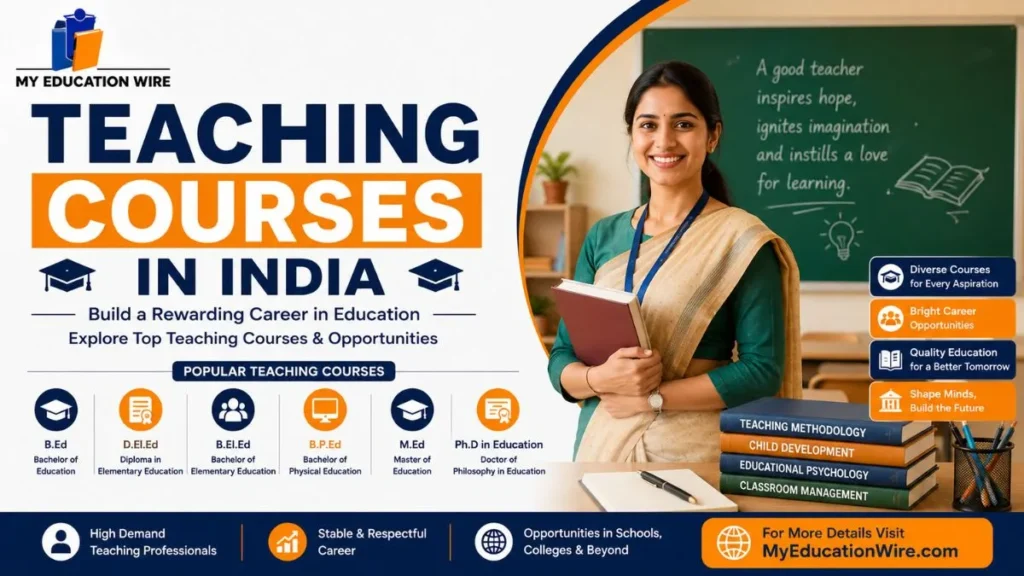
You can pursue Teaching Courses in India at diploma, undergraduate, postgraduate, and doctoral levels. These programmes prepare candidates to teach at pre-primary, primary, secondary, senior secondary, and higher education levels.
Why Choose Teaching as a Career?
Teaching Courses in India offers excellent career opportunities in government schools, private schools, colleges, universities, coaching institutes, educational technology (EdTech) companies, and educational administration. Apart from job security, the profession provides opportunities for research, curriculum development, educational leadership, and lifelong learning.
Teaching Courses in India: Vacancies Scenario
Across India, government school teaching vacancies are not filled on a fixed annual national quota; they vary by state, board, and recruitment cycle. A widely cited Ministry of Education figure reported over 8.4 lakh vacant teaching posts in government schools, with about 7.2 lakh at the primary level and 1.2 lakh at the secondary level.
For a more recent national estimate, a parliamentary-panel-based report said the school system had about 9.82 lakh vacant teaching posts in 2024–25, up from 9.59 lakh in 2023–24. That figure covers primary and secondary levels across the school system, including central and state-run institutions.
Types of Teaching Courses in India
Teacher education programmes are available after Class 10, Class 12, graduation, and postgraduation.
1. Diploma Courses
Diploma programmes provide foundational teacher training and are suitable for candidates interested in early childhood or elementary education.
Popular Diploma Courses
| Diploma Course | Brief Description |
|---|---|
| Diploma in Elementary Education (D.El.Ed.) | A teacher training programme that prepares candidates to teach students at the primary and upper primary levels through pedagogy, child development, and classroom management. |
| Diploma in Nursery Teacher Training (NTT) | Focuses on early childhood education, child psychology, play-way teaching methods, classroom activities, and overall development of preschool children. |
| Diploma in Early Childhood Care and Education (ECCE) | Covers child development, nutrition, health, learning methods, and teaching techniques for children from birth to eight years of age. |
| Diploma in Physical Education (D.P.Ed.) | Trains candidates in physical fitness, sports coaching, health education, exercise science, and organizing sports and recreational activities in schools. |
| Diploma in Special Education | Prepares teachers to educate children with disabilities by focusing on inclusive education, special teaching methods, rehabilitation, and individualized learning strategies. |
Duration: 1–2 years
Eligibility: Class 12 from a recognised board (minimum marks vary by institute).
2. Undergraduate Teaching Courses in India
Students can pursue undergraduate teacher education immediately after Class 12 or after graduation.
Popular Undergraduate Teaching Courses
| Undergraduate Teaching Course | Brief Description |
|---|---|
| Bachelor of Education (B.Ed.) | A professional teacher education programme that prepares graduates to teach at the secondary and senior secondary levels through pedagogy, educational psychology, and school internships. |
| Bachelor of Elementary Education (B.El.Ed.) | Focuses on preparing teachers for primary and upper primary schools by combining child development, teaching methods, and practical classroom training. |
| B.A. B.Ed. | A four-year integrated programme that combines arts subjects with professional teacher training, preparing graduates to teach humanities and social sciences. |
| B.Sc. B.Ed. | An integrated programme combining science education with teacher training, enabling graduates to teach science and mathematics at the school level. |
| B.Com. B.Ed. | Integrates commerce education with teaching methodologies, preparing candidates to teach commerce, business studies, and related subjects in schools. |
| Bachelor of Physical Education (B.P.Ed.) | Focuses on physical fitness, sports science, coaching techniques, health education, and sports management for careers as physical education teachers. |
| Bachelor of Special Education | Prepares teachers to educate students with disabilities through inclusive teaching practices, special education techniques, and individualized learning strategies. |
| Integrated Teacher Education Programme (ITEP) | A four-year integrated programme combining a bachelor’s degree with teacher education, designed under NEP 2020 to prepare qualified school teachers through comprehensive academic and practical training. |
The ITEP is a four-year integrated programme introduced under NEP 2020, combining a bachelor’s degree with professional teacher education. Admission is through the National Common Entrance Test (NCET) conducted by the National Testing Agency (NTA).
3. Postgraduate Teaching Courses
Candidates interested in advanced studies can pursue:
Popular Postgraduate Teaching Courses
| Postgraduate Teaching Course | Brief Description |
|---|---|
| Master of Education (M.Ed.) | An advanced teacher education programme focusing on educational research, curriculum development, teacher training, educational administration, and policy. |
| M.A. Education | Covers educational philosophy, sociology, psychology, curriculum planning, educational management, and research for careers in teaching and academia. |
| M.Sc. Education | Focuses on scientific approaches to education, educational measurement, research methodologies, psychology, and instructional technologies. |
| M.P.Ed. (Master of Physical Education) | An advanced programme covering sports science, exercise physiology, sports psychology, coaching, fitness management, and physical education research. |
| M.A. Educational Leadership | Prepares candidates for leadership roles in educational institutions through training in school administration, policy, strategic planning, and organizational management. |
| M.A. Educational Psychology | Focuses on learning theories, child and adolescent development, counselling, assessment, motivation, and psychological principles in education. |
Duration: Usually 2 years.
4. Doctoral Programmes
Candidates interested in research and academics may pursue:
- Ph.D. in Education
- Ph.D. in Educational Psychology
- Ph.D. in Curriculum Studies
- Ph.D. in Teacher Education
- Ph.D. in Educational Technology
These programmes prepare scholars for university teaching, research, policy-making, and educational consultancy.
What is the TET or CTET Test? : Teaching Courses in India
This is the eligibility test for the teacher who have completed their diploma or degree to prove their eligibility. No government schools will permit you to appear for the government teacher job until you have this CTET or TET pass certificate.
Popular Teaching Courses in India
Diploma in Elementary Education (D.El.Ed.)
A professional diploma designed to prepare teachers for primary and upper primary schools. The programme covers child development, pedagogy, classroom management, educational psychology, and teaching practice.
Nursery Teacher Training (NTT)
Focuses on early childhood education, play-way learning, child psychology, communication skills, and classroom activities for preschool children.
Bachelor of Education (B.Ed.)
B.Ed. is the most popular teacher education programme for graduates aspiring to become secondary and senior secondary school teachers. The curriculum includes educational psychology, pedagogy, teaching methodologies, assessment, ICT, and school internships.
Bachelor of Elementary Education (B.El.Ed.)
This programme prepares teachers for teaching Classes I to VIII by integrating education theory, pedagogy, and extensive school-based training.
Integrated B.A. B.Ed., B.Sc. B.Ed., and B.Com. B.Ed.
These four-year integrated programmes allow students to complete both a bachelor’s degree and a B.Ed. simultaneously, saving one academic year compared to pursuing the degrees separately.
Master of Education (M.Ed.)
M.Ed. is intended for candidates seeking careers in teacher education, educational administration, curriculum development, educational research, and higher education.
Teaching Courses in India: Eligibility Criteria
- Diploma courses: After Class 12, you can join a diploma if you meet the institute’s minimum marks requirement.
- B.Ed.: A teacher-training degree for school teaching, usually after graduation or postgraduation with the required marks.
- B.El.Ed.: An integrated course for becoming a primary-level teacher after Class 12, with the university’s cutoff marks.
- ITEP: A four-year integrated teacher education course after Class 12, with admission through NCET.
- M.Ed.: A higher teacher-education degree after B.Ed. or an equivalent education-related bachelor’s degree.
- Ph.D.: The highest research degree in education, usually after a master’s degree plus entrance test/interview.
Teaching Courses in India: Admission Process
Admission procedures vary by course and institution.
- Check Eligibility: Confirm the required qualification, marks, age, and category rules.
- Register Online: Fill and submit the application form with documents and fee.
- Entrance Examination: Take the test if the course or university requires one.
- Merit List: Selected candidates are listed based on exam score or marks.
- Counselling: Final seat allotment, document verification, and admission confirmation happen here.
For Indian university admissions, this process is commonly used across UG and teacher-education courses, though the exact steps can differ by institution and program.
Teacher Vacancies
If your question is “how many teaching vacancies come out in a year,” the most accurate answer is:
- Vacancies notified for recruitment in a year can be much lower or higher than the total vacant posts, because departments do not recruit all vacancies at once.
- Total vacant teaching posts nationwide are roughly in the 8.4 to 9.8 lakh range in the latest available reports.
- Primary level makes up the largest share of vacancies, followed by secondary and senior secondary levels.
Admission procedures vary by course and institution.
Step 1: Check Eligibility
Ensure you satisfy the educational qualifications, age requirements (if any), and minimum marks.
Step 2: Register Online
Complete the online application form with personal, academic, and category details.
Step 3: Entrance Examination
Many universities admit students through entrance examinations.
Popular entrance examinations include:
- NCET
- CUET
- State B.Ed. Entrance Tests
- University-specific entrance examinations
Step 4: Merit List
Candidates are shortlisted based on entrance examination scores or qualifying examination marks.
Step 5: Counselling
Qualified candidates participate in counselling for seat allotment, document verification, and admission.
Admission is usually done in this order: check eligibility, apply online, appear for entrance test if needed, wait for merit list, and attend counselling for seat allotment.
Very briefly, each step means:
- Check Eligibility: Confirm the required qualification, marks, age, and category rules.
- Register Online: Fill and submit the application form with documents and fee.
- Entrance Examination: Take the test if the course or university requires one.
- Merit List: Selected candidates are listed based on exam score or marks.
- Counselling: Final seat allotment, document verification, and admission confirmation happen here.
For Indian university admissions, this process is commonly used across UG and teacher-education courses, though the exact steps can differ by institution and program.
Distance Learning B.Ed. Courses
“Admission varies by university: central universities often use CUET, while many state, private, and institution-specific universities use their own entrance or merit-based process.”
B.Ed. Distance Course Universities or Colleges
B.Ed distance course is available in some universities and open universities, but you should only choose programs that are officially recognized.
Some commonly listed options include:
- IGNOU
- Netaji Subhas Open University
- YCMOU
- BRAOU
- TNOU
- KSOU
- Nalanda Open University
- University of Kalyani
- Panjab University
- Guru Nanak Dev University
- Kurukshetra University
- Jamia Millia Islamia
- Maharshi Dayanand University
- University of Madras
- University of Kerala
Before admission, check whether the university’s B.Ed distance/ODL program is currently approved for the academic session, because recognition can change.
Entrance Exams for Teaching Courses
Some of the major entrance examinations include:
| Entrance Exam | Conducting Authority | State/Level |
|---|---|---|
| National Common Entrance Test (NCET) | National Testing Agency (NTA) | National |
| RIE CEE (Regional Institute of Education Common Entrance Examination) | NCERT | All India |
| Bihar B.Ed. CET | Lalit Narayan Mithila University | Bihar |
| UP B.Ed. Joint Entrance Examination | Designated State University | Uttar Pradesh |
| MAH B.Ed. CET | State CET Cell | Maharashtra |
| TS EdCET | Telangana Council of Higher Education | Telangana |
| AP EdCET | Andhra Pradesh State Council of Higher Education | Andhra Pradesh |
| Odisha B.Ed. Entrance Examination | Higher Education Department, Odisha | Odisha |
| Rajasthan PTET | VMOU, Kota | Rajasthan |
| CG Pre B.Ed. | CG Vyapam | Chhattisgarh |
| Jharkhand B.Ed. Entrance Competitive Examination | JCECEB | Jharkhand |
| MP B.Ed. Admission/Entrance (if notified) | MP Employees Selection Board | Madhya Pradesh |
| Himachal Pradesh B.Ed. Entrance Test | Himachal Pradesh University | Himachal Pradesh |
| Jammu & Kashmir B.Ed. Entrance Test | University of Jammu/University of Kashmir | Jammu & Kashmir |
| Karnataka B.Ed. Admission Test/Merit | Karnataka Government/Universities | Karnataka |
| Punjab B.Ed. Admissions | Punjab Government/Participating Universities | Punjab |
| Haryana B.Ed. Admissions | Designated State University | Haryana |
| Assam B.Ed. Entrance Test | Gauhati University, Dibrugarh University, etc. | Assam |
| Kerala B.Ed. Admissions | State Universities | Kerala |
| Tamil Nadu B.Ed. Admissions | TNTEU/Universities | Tamil Nadu |
| Gujarat B.Ed. Admissions | Gujarat Universities | Gujarat |
| Goa B.Ed. Admissions | Goa University | Goa |
| Uttarakhand B.Ed. Entrance | HNB Garhwal University/Kumaun University | Uttarakhand |
| West Bengal B.Ed. Admissions | State Universities | West Bengal |
| Manipur B.Ed. Entrance | Manipur University | Manipur |
| Mizoram B.Ed. Admissions | Mizoram University | Mizoram |
| Meghalaya B.Ed. Admissions | NEHU | Meghalaya |
| Nagaland B.Ed. Admissions | Nagaland University | Nagaland |
| Sikkim B.Ed. Admissions | Sikkim University | Sikkim |
| Arunachal Pradesh B.Ed. Admissions | Rajiv Gandhi University | Arunachal Pradesh |
Read also: Himachal Pradesh Teacher Vacancies 2026
University-Level B.Ed. Admission
Several universities conduct their own entrance tests or admit students based on merit. Some prominent institutions include:
- BHU: Mostly through CUET-based admission, followed by BHU’s own registration/counselling process.
- University of Delhi: Admission is through the applicable DU process, usually based on CUET and centralized counselling.
- JMI: Admission is by Jamia’s own entrance-based process for many courses, as per its prospectus.
- AMU: Usually follows its own entrance/admission procedure for many programs.
- GGSIPU: Usually uses its own entrance or merit-based counselling system, depending on the course.
- Kurukshetra University: Admission is typically through university or state-level merit/entrance process.
- Panjab University: Usually follows its own entrance/merit-based admission system.
- MDU: Admission is generally through a university-level or state-level process.
- Dr. B.R. Ambedkar University: Admission is usually through the university’s prescribed process.
- Guru Nanak Dev University: Usually uses merit/entrance-based admission as notified by the university.
- Central University of South Bihar: Admission is generally through CUET-based centralized admission.
- Central University of Rajasthan: Admission is generally through CUET-based centralized admission.
- Other central, state, and private universities: Admission may be through CUET, state entrance tests, university entrance tests, or merit-based selection, depending on the institution.
Here is your content formatted only. I have not changed any words, not added another H1, and preserved your content exactly.
Subjects Taught
Teaching Courses in India education programmes generally include:
- Educational Psychology
- Child Development
- Pedagogy
- Curriculum and Instruction
- Assessment and Evaluation
- Inclusive Education
- Educational Technology
- Classroom Management
- Educational Philosophy
- Sociology of Education
- Guidance and Counselling
- ICT in Education
- School Internship
- Teaching Practice
Skills Required
Successful teachers generally possess:
- Communication skills
- Leadership
- Patience
- Creativity
- Classroom management
- Problem-solving
- Subject expertise
- Adaptability
- Critical thinking
- Empathy
Top Recruiters
Graduates can work in:
- Government schools
- Kendriya Vidyalayas
- Navodaya Vidyalayas
- State government schools
- Private schools
- International schools
- Colleges
- Universities
- Coaching institutes
- EdTech companies
- NGOs
- Educational consultancies
Career Opportunities
After completing a Teaching Courses in India, candidates may work as:
- Primary Teacher (PRT)
- Trained Graduate Teacher (TGT)
- Post Graduate Teacher (PGT)
- Nursery Teacher
- Special Educator
- Physical Education Teacher
- Lecturer
- Assistant Professor
- Academic Coordinator
- School Counsellor
- Curriculum Developer
- Educational Consultant
- Instructional Designer
- Online Educator
- Education Officer
Also read: DSSSB TGT Recruitment 2026
Salary After Doing a Teaching Courses in India
Approximate annual salary ranges are:
| Position | Average Annual Salary |
|---|---|
| Primary Teacher | ₹2.5–5 lakh |
| TGT | ₹4–7 lakh |
| PGT | ₹5–9 lakh |
| Government School Teacher | ₹5–10 lakh |
| Lecturer | ₹4–8 lakh |
| Assistant Professor | ₹6–12 lakh |
| School Principal | ₹8–18 lakh |
| Educational Consultant | ₹6–15 lakh |
Actual salaries depend on qualifications, employer, experience, and location.
Government vs Private Institutions
Government teacher education colleges generally offer lower tuition fees and admissions through centralized counselling, whereas private colleges provide a wider range of programmes and infrastructure but often charge higher fees.
Importance of Practical Training
Teaching Courses in India include school internships, classroom observation, lesson planning, teaching demonstrations, and community engagement. These practical components help candidates gain real classroom experience and develop professional teaching skills. NCTE regulations also emphasize practicum, internships, and school-based activities as essential parts of teacher education.
Future Scope: Teaching Courses in India
The demand for qualified teachers is expected to remain strong due to expanding school education, digital learning platforms, and reforms under NEP 2020. Opportunities are also increasing in online education, educational content development, curriculum design, educational research, and teacher training. The rollout of ITEP and NCET is intended to standardize and strengthen teacher preparation across the country.
In The End
If you love teaching and school environment teaching is best suited for you. Teaching courses in India offer structured pathways for students at every stage of education—from diploma programmes after Class 12 to postgraduate and doctoral studies. Whether aspiring to teach young children, secondary school students, or university learners, candidates can choose programmes such as DEIDd, BEd, BEIEd, integrated BA/BSc/BCom/MEd, or PhD in Education. With growing emphasis on quality teacher education, practical training, and professional development, teaching continues to be a stable, respected, and impactful career option with opportunities in schools, higher education institutions, educational organizations, and the rapidly expanding EdTech sector.
FAQs
1. Who can apply for the teaching courses in India?
Graduates with a bachelor’s degree from a recognized university can apply, subject to the programme’s eligibility criteria.
2. Are the teaching courses offered fully online?
Yes. The programmes are delivered entirely online, allowing learners to study from anywhere.
3. Which teaching courses are available?
CUTN Online offers M.A. English and M.A. Hindi under its online postgraduate programmes.
4. Are these courses suitable for working professionals?
Yes. The flexible online format makes it ideal for teachers, working professionals, and aspiring educators.
5. What career opportunities do these courses offer?
Graduates can explore careers in teaching, research, content writing, publishing, translation, and government sectors.
6. Why choose CUTN Online for teaching courses?
CUTN Online offers a Central University degree, experienced faculty, flexible learning, and a curriculum designed to support academic and professional growth.