
NLSAT 2027 is the entrance examination conducted by NLSIU Bengaluru for admission to its prestigious 3-Year LL.B. (Hons.) programme. The exam is expected to be held on 25 April 2027, with registrations likely to begin in November 2026. It assesses candidates’ reading, reasoning, analytical, and legal writing skills.
Table of Contents
The National Law School Admission Test (NLSAT) is one of India’s most prestigious law entrance examinations conducted by the National Law School of India University (NLSIU), Bengaluru for admission to its highly regarded 3-Year LL.B. (Hons.) program. Unifying conventional law entrance exams, NLSAT is designed to assess a candidate’s critical thinking, reading comprehension, analytical reasoning, and structured legal writing abilities rather than prior legal knowledge.
The NLSAT 2027 Exam to attract thousands of applicants from across the country seeking admission to one of India’s top-ranked law schools. This comprehensive guide covers the NLSAT 2027 Exam Date, Eligibility Criteria, Registration Process, Exam Pattern, Syllabus, Preparation Strategy, Selection Process, Important Dates, and Expert Tips for aspirants.
What is NLSAT 2027?
The National Law School Admission Test (NLSAT) is the entrance examination conducted by NLSIU Bengaluru for admission to its 3-Year LL.B. (Hons.) degree program.
Unlike CLAT or other law entrance exams that focus heavily on legal aptitude and objective questions, NLSAT emphasizes:
- Reading comprehension
- Critical reasoning
- Analytical thinking
- Logical application
- Structured legal writing
- Essay writing skills
The exam is specifically designed for graduates seeking a career in law after completing their bachelor’s degree.
NLSAT 2027 Highlights
| Particulars | Details |
| Exam Name | National Law School Admission Test (NLSAT) |
| Conducting Body | National Law School of India University (NLSIU), Bengaluru |
| Course Offered | 3-Year LL.B. (Hons.) |
| Academic Session | 2027–2030 |
| Exam Level | National |
| Mode of Examination | Offline/Descriptive & Objective |
| Duration | 150 Minutes |
| Total Marks | 150 Marks |
| Eligibility | Graduate Degree |
| Official Website | nls.ac.in |
Why NLSAT is Different from Other Law Entrance Exams
Most law entrance examinations focus on memorization-based General Knowledge, Legal Aptitude, and Current Affairs. NLSAT takes a completely different approach.
The examination evaluates:
- Deep reading ability
- Interpretation skills
- Structured argumentation
- Problem-solving aptitude
- Writing proficiency
- Analytical reasoning
This makes NLSAT one of the most intellectually demanding law entrance exams in India.
NLSAT 2027 Exam Important Dates
Although official dates are yet to be announced, the examination follows a relatively predictable timeline.
Expected NLSAT 2027 Schedule
| Event | Expected Date |
| Official Notification Release | Mid-November 2026 |
| Online Registration Begins | November 2026 |
| Last Date to Apply | March 2027 |
| Application Correction Window | March/April 2027 |
| Admit Card Release | Mid-April 2027 |
| NLSAT 2027 Exam Date | 25 April 2027 (Tentative) |
| Answer Key Release | May 2027 |
| Result Declaration | Late May 2027 |
| Merit List Publication | May/June 2027 |
| Admission Process | June 2027 |
NLSAT 2027 Eligibility Criteria
Before applying, candidates must carefully review the eligibility requirements.
Educational Qualification
Applicants must possess:
- A Bachelor’s Degree from a recognized university.
- Final-year graduation students can also apply provisionally.
Eligible graduates include:
- BA
- BSc
- BCom
- BBA
- BTech
- BE
- BCA
- BSW
- Any equivalent undergraduate degree
Minimum Marks Requirement
| Category | Minimum Aggregate Marks |
| General | 45% |
| OBC | 45% |
| EWS | 45% |
| SC | 40% |
| ST | 40% |
| PwD | 40% |
Age Limit
One of the most attractive features of NLSAT is the absence of an upper age limit.
| Particulars | Requirement |
| Minimum Age | As per graduation completion |
| Maximum Age | No Upper Age Limit |
This makes the exam ideal for:
- Working professionals
- Career changers
- Government employees
- Corporate professionals
- Civil Services aspirants
Other Topic: LLM Admission 2026
NLSAT 2027 Admission Process
The admission process consists of several stages:
- Step-1: Open your search engine and from NLU Website complete your registration process and fill the online application form.
- Step-2: Successfully registered and Eligible candidates receive admit cards before the examination.
- Step-3: Candidates take the NLSAT entrance examination 2026.
- Step-4: Part A and Part B papers are assessed according to NLSIU’s selection criteria.
- Step-5: Successful candidates are shortlisted.
- Step-6: Selected candidates complete admission formalities.
NLSAT 2027 Exam Pattern
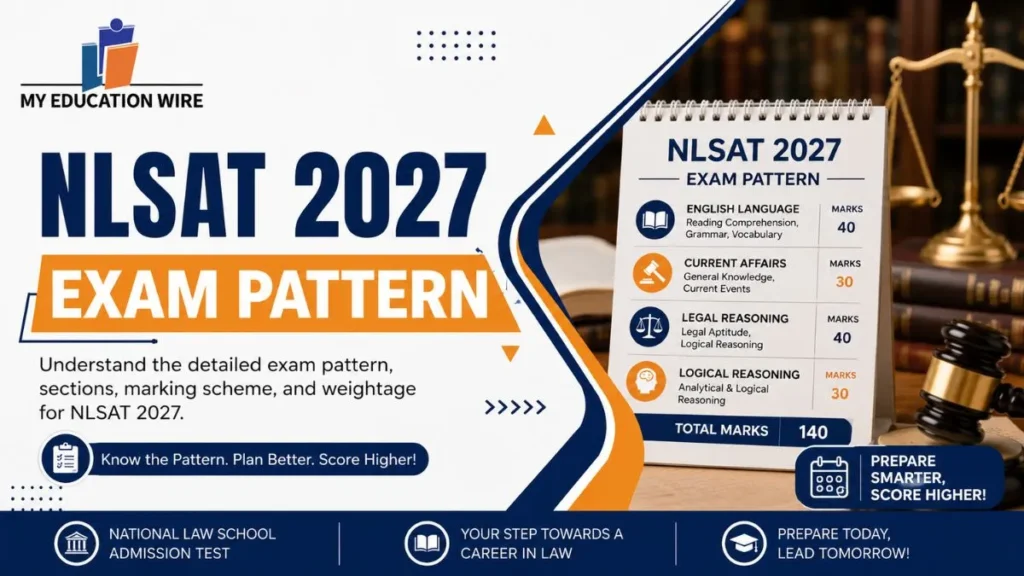
The NLSAT examination consists of a single paper divided into two major sections.
NLSAT Exam Structure
| Section | Marks |
| Part A | 75 Marks |
| Part B | 75 Marks |
| Total | 150 Marks |
Exam Duration
| Particular | Details |
| Duration | 150 Minutes |
| Total Marks | 150 |
| Sections | 2 |
Part A: Objective Section
Part A acts as the primary screening stage.
Part A Overview
| Component | Details |
| Type | Multiple Choice Questions |
| Marks | 75 |
| Reading Passages | Yes |
| Negative Marking | Applicable |
Subjects Covered
- Reading Comprehension
- Critical Reasoning
- Current Affairs
- General Knowledge
Negative Marking Rule
NLSAT follows a unique scoring system.
| Response Type | Marks |
| Correct Answer | +1 |
| Incorrect Answer | -0.25 |
| Unattempted Question | -0.25 |
This means leaving questions unanswered can also result in a penalty.
Why Part A is Extremely Important
Part A functions as a filtration stage. Only candidates who perform exceptionally well in Part A move forward in the evaluation process.
Typically:
- Approximately five candidates per available seat are shortlisted.
- Only shortlisted candidates have their Part B responses evaluated.
Therefore, strong performance in Part A is absolutely critical.
Part B: Subjective Section
Part B determines the final ranking among shortlisted candidates.
Structure of Part B
| Section | Marks |
| Legal Aptitude | 60 |
| Analytical Essay | 15 |
| Total | 75 |
Legal Aptitude Section
The Legal Aptitude section contains scenario-based questions.
Key Features
- Problem-solving based
- Logic-oriented
- No prior legal education required
- Application of provided legal principles
Candidates are expected to analyze situations logically and provide structured responses.
Understanding the IRAC Method
NLSIU strongly values logical legal reasoning. Students should practice the IRAC Framework:
| IRAC Component | Meaning |
| I | Issue |
| R | Rule |
| A | Analysis |
| C | Conclusion |
This framework helps candidates answer legal problems systematically.
Analytical Essay Section
The essay evaluates:
- Writing ability
- Argument structure
- Clarity of thought
- Analytical depth
Candidates may be asked to write approximately 500 words on:
- Public policy
- Constitutional issues
- Social justice
- Technology regulation
- Contemporary affairs
NLSAT 2027 Syllabus
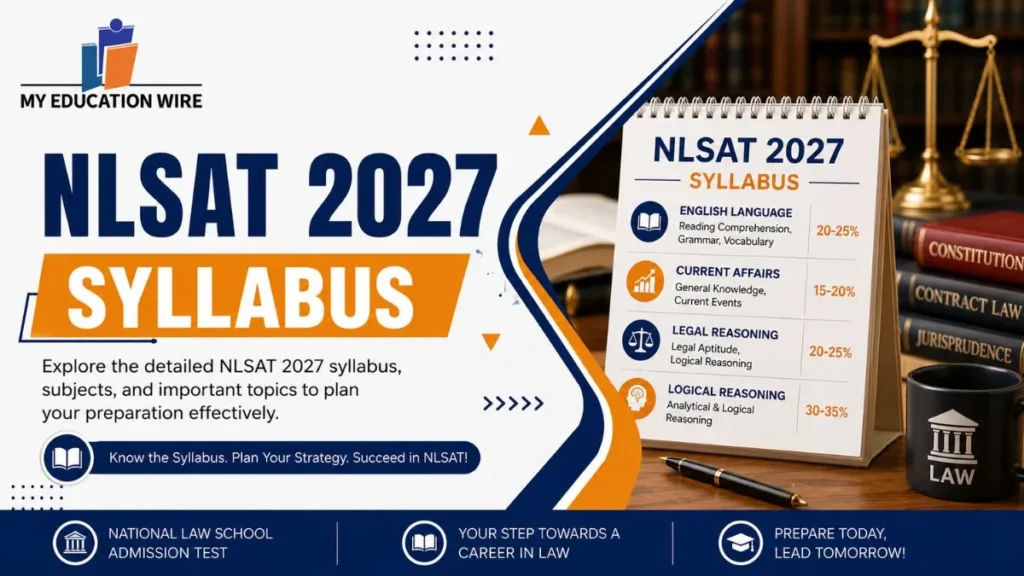
Unlike traditional exams, NLSAT does not prescribe an extensive syllabus. Instead, it focuses on aptitude-based assessment.
Reading Comprehension
Topics include:
- Editorials
- Opinion articles
- Academic writing
- Legal passages
- Public policy discussions
Critical Reasoning
Candidates must analyze:
- Arguments
- Assumptions
- Logical flaws
- Conclusions
- Inferences
Current Affairs and General Knowledge
Important areas include:
- Constitutional developments
- Supreme Court judgments
- International relations
- Government policies
- Economic developments
Legal Aptitude
Focuses on:
- Application of legal principles
- Logical analysis
- Problem-solving
- Structured reasoning
No prior legal knowledge is required.
Best Preparation Strategy for NLSAT 2027
Since NLSAT tests skills rather than memorized knowledge, preparation must be different from CLAT or AILET Exam 2027.
Improve Reading Speed
Candidates should read daily:
- The Hindu
- Indian Express
- LiveLaw
- Bar and Bench
- Economic Times
Reading complex material improves comprehension and analytical thinking.
Develop Critical Thinking
Practice:
- Editorial analysis
- Argument evaluation
- Logical reasoning exercises
This strengthens Part A performance.
Build Legal Writing Skills
Write answers regularly using IRAC. Focus on:
- Structure
- Precision
- Logic
- Clarity
Practice Essays Weekly
Write essays on:
- Constitutional law
- Technology
- Public policy
- Governance
- Human rights
This improves Part B scores.
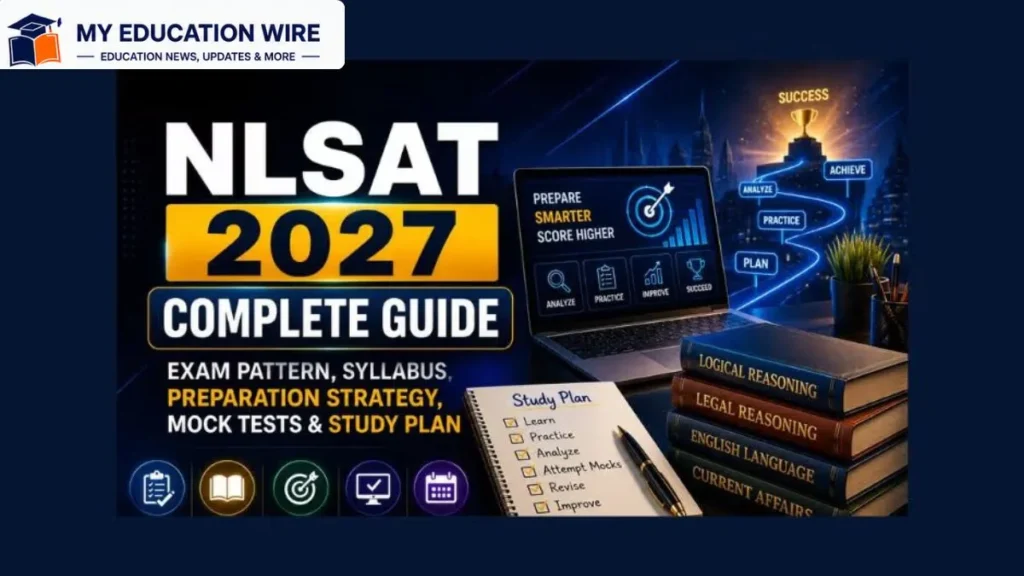
12-Month Preparation Plan for NLSAT 2027
| Preparation Phase | Focus Area |
| Months 1–3 | Reading & Current Affairs |
| Months 4–6 | Critical Reasoning Practice |
| Months 7–9 | Legal Aptitude & IRAC Writing |
| Months 10–11 | Mock Tests |
| Month 12 | Revision & Full-Length Papers |
Common Mistakes to Avoid
Many candidates fail due to avoidable errors.
Major Mistakes
- Ignoring reading practice
- Weak writing skills
- Poor time management
- Lack of mock test practice
- Not understanding negative marking
Avoiding these mistakes can significantly improve scores.
Why Working Professionals Prefer NLSAT
The 3-Year LL.B. (Hons.) program attracts:
- Engineers
- Chartered Accountants
- MBA Graduates
- Civil Servants
- Corporate Professionals
because:
- No upper age limit exists.
- Diverse educational backgrounds are accepted.
- Strong career transition opportunities are available.
Career Opportunities After NLSIU 3-Year LL.B.
Graduates from NLSIU enjoy excellent career prospects. Popular career options include:
- Advocate
- Corporate Lawyer
- Legal Consultant
- Judicial Services Officer
- Policy Analyst
- Legal Researcher
- Public Prosecutor
- Compliance Officer
- In-House Counsel
FAQs
Q1. When will the NLSAT 2027 application form be released?
The NLSAT 2027 Registration Process is expected to begin in November 2026.
Q2. What is the eligibility criteria for NLSAT 2027?
Candidates must hold a Bachelor’s degree from a recognized university with the required minimum qualifying marks.
Q3. Can final-year graduation students apply for NLSAT 2027?
Yes, final-year undergraduate students can apply provisionally for NLSAT 2027.
Q4. What are the minimum marks required for NLSAT admission?
General, OBC, and EWS candidates require 45% marks, while SC, ST, and PwD candidates require 40% marks.
Q5. Is there any age limit for NLSAT 2027?
No, there is no upper age limit for appearing in the NLSAT examination.
Q6. Which newspapers are recommended for NLSAT preparation?
Students should regularly read: The Hindu, Indian Express, Economic Times, LiveLaw, and Bar & Bench.
Q7. What subjects are covered in NLSAT Part A?
Part A includes: Reading Comprehension, Critical Reasoning, Current Affairs, and General Knowledge.
Q8. What is the IRAC method in NLSAT?
IRAC (Issue, Rule, Analysis, Conclusion) is a legal reasoning framework used to answer legal aptitude questions effectively.
Q9. Why is NLSIU Bengaluru considered a top law school?
NLSIU Bengaluru is consistently ranked among India’s best law universities for its academic excellence, faculty, legal research, placements, and industry reputation.
Q10. What is NLSAT 2027?
NLSAT 2027 (National Law School Admission Test) is the entrance exam conducted by NLSIU Bengaluru for admission to its 3-Year LL.B. (Hons.) program.
Other Topic: IBPS PO Notification 2026