
Read about 35% to 40% Fake Lawyers Supreme Court Examines Digital Register:
The Core Problem of Fake Lawyers Supreme Court
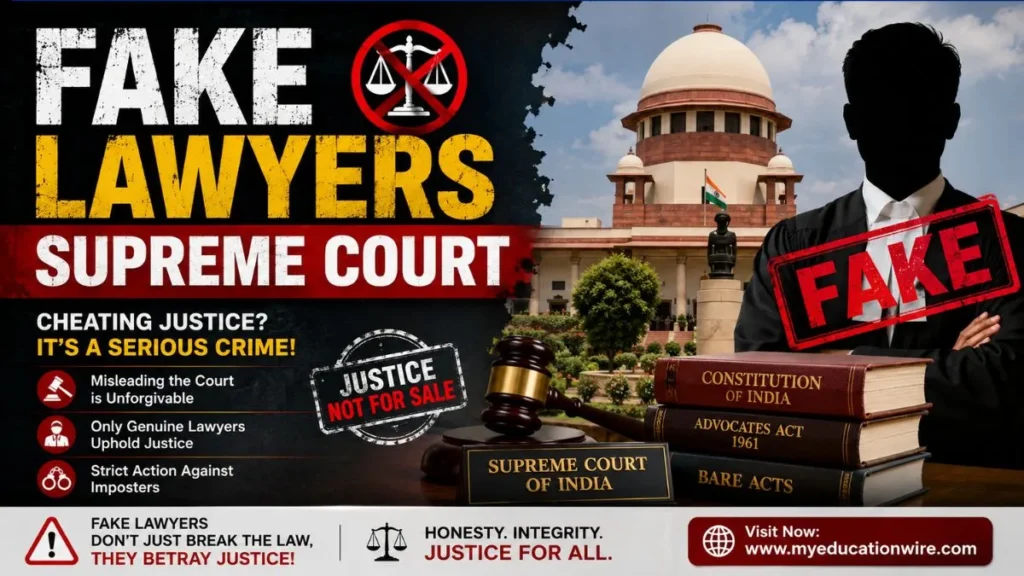
The Supreme Court of India (SC) has agreed to examine a plea seeking the creation of a national digital register for advocates. This system is envisioned as a permanent, technology-driven infrastructure similar to the Aadhaar system. The move comes amid startling revelations that approximately one in every three practicing advocates in the country may be fake. Specifically, a recent statement by the Bar Council of India (BCI) chairperson indicated that roughly 35% to 40% of those practicing in courts do not possess genuine law degrees.
Fake Lawyers Supreme Court Legal Representation & Arguments
The public interest litigation (PIL) was brought forward by the Bar Association of India (BAI). Representing the BAI, counsels Prashant Kumar and Vipin Nair argued that “judicial independence of the legal profession is at stake.” They emphasised that current periodic degree verification drives conducted by the BCI are merely ad-hoc measures. Instead, they pushed for a more structural solution to eradicate individuals operating without valid qualifications.
Supreme Court’s Response and Implementation Hurdles
The matter was heard by a bench comprising Chief Justice of India (CJI) Surya Kant and Justice V Mohana. CJI Kant described the digital registry proposal as an “innovative one” that leverages modern technology effectively. However, he noted that executing this plan requires significant systemic cooperation:
- University Integration: It requires the impleadment of all universities that confer law degrees. These institutions must be instructed to reveal lists of individuals who have genuinely secured the required legal qualifications.
- Targeting Misconduct: CJI Kant specifically highlighted concerns regarding the authenticity of law degrees held by certain advocates who post derogatory comments about the judiciary on social media, noting a prima facie conviction that such individuals entered the profession through backdoor channels.
- Seeking Feedback: The bench has officially sought responses on the PIL from the Union government, the BCI, the University Grants Commission (UGC), and state bar councils.
Supporting Young Lawyers
The court and counsel both agreed that filtering out fake lawyers is vital for empowering legitimate legal professionals. The bench noted that the ultimate goal is to sideline masqueraders while encouraging and strengthening the “young lawyers and future generation.” This can be achieved through:
- Providing periodic training (as is currently done by some advocate bodies).
- Ensuring young lawyers are given dedicated space and brought to the forefront in courts.
- Implementing strict guidelines on dos and don’ts to properly regulate advocates’ social media activities.
FAQs
Q1: What is the main issue being addressed by the Supreme Court regarding lawyers?
- A: The Supreme Court is examining a public interest litigation (PIL) to address the alarming issue of fake lawyers practicing in courts. According to a statement by the Bar Council of India (BCI) chairperson, approximately 35% to 40% (nearly 1 in 3) of practicing advocates may not hold genuine law degrees.
Q2: What solution has been proposed to tackle this problem?
- A: The Bar Association of India (BAI) has suggested creating a permanent, technology-driven national digital register for advocates, functioning along the lines of the Aadhaar system.
Q3: Why are current verification measures considered insufficient?
- A: The BAI’s counsels argued that the current degree verification drives conducted by the BCI are merely ad-hoc measures. They believe a permanent digital registry is necessary to protect the “judicial independence of the legal profession”.
Q4: What challenge did Chief Justice of India (CJI) Surya Kant point out regarding the digital registry?
- A: CJI Kant noted that implementing the system would require the cooperation and “impleadment of all universities” that grant law degrees. These universities would need to share their official lists of genuinely qualified graduates to verify who is legally entitled to practice.
Q5: How does this issue connect to social media misconduct?
- A: CJI Kant expressed doubts about the authenticity of degrees held by certain advocates who post derogatory comments about the judiciary on social media, suggesting they likely entered the legal profession through “backdoor entries”.
Q6: How will this digital filtering benefit legitimate, younger lawyers?
- A: By sidelining fake lawyers, the system aims to clear space for genuine professionals. The court emphasized the need to support the “young lawyers and future generation” by giving them dedicated space in courts, periodic training, and clear guidelines regarding social media usage.
Another Topics : JEE Main 2027 Syllabus