
How to prepare is the first step to your success. To crack the All India Law Entrance Test (AILET) 2027 demands a sharp transition from rote memorization to high-speed information processing. With National Law University, Delhi (NLU Delhi), as the competition is high and to filter thousands of applicants for roughly 120 seats, relying on general study routines will not suffice. Because the current exam structure places a premium on cognitive endurance, your preparation must treat reading stamina and precise logic as core fundamentals rather than elective skills.
Strategic AILET 2027 Preparation Tips Overview
Success in AILET 2027 Exam requires a targeted strategy centered around its specific 150-question, 120-minute reality:
Simulated Mock Drills: Attempt full-length, offline mock tests under strict exam conditions to build the physical endurance required for the real paper.
Mastering the Logic Core: Since Logical Reasoning (Section C) controls nearly 47% of the total score and acts as the primary tie-breaker, dedicate half of your daily prep time to critical reasoning, syllogisms, and contextual legal application drills.
Active Reading & Elimination: Cultivate a daily editorial reading habit (The Hindu or The Indian Express) to comfortably process long-form English comprehension passages. Practice the art of option elimination to stay within the 48-seconds-per-question limit.
Fact-Based GK Tracking: Unlike CLAT’s passage-heavy general knowledge, AILET focuses heavily on direct, fact-based current affairs. Maintain structured timelines of major global events and legal updates over the last 12–15 months.

“Before starting the AILET 2027 Preparation, you need to understand the NLU exam Syllabus and Exam Pattern first.”
1. Deconstruct the AILET 2027 Exam Pattern
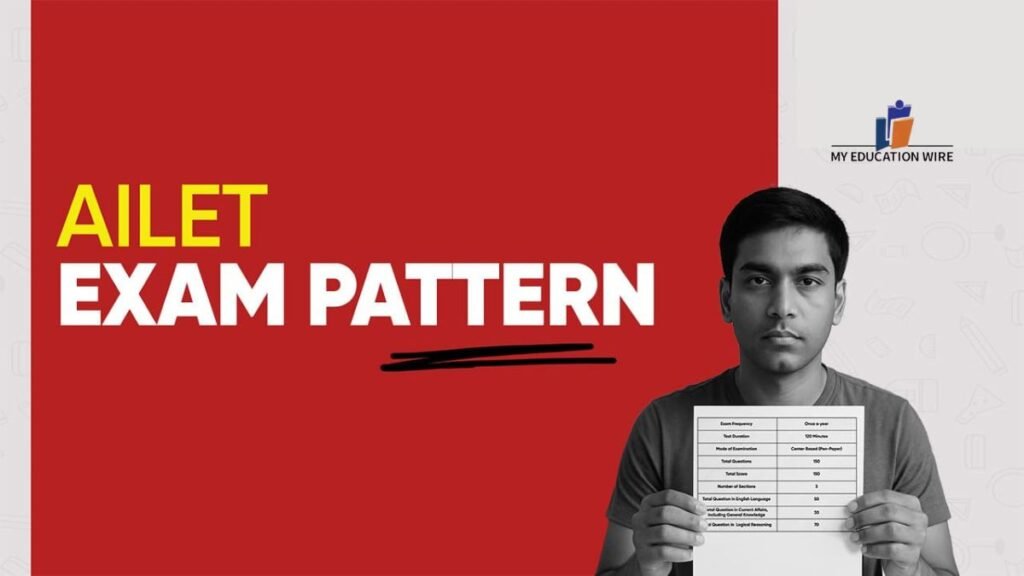
Before picking up any book, memorize the blueprint of the exam. AILET relies on a streamlined three-section structure with no sectional time limits. Every correct response awards +1 mark, while a wrong answer penalizes you by -0.25 marks.
| Section | Number of Questions | Marks | Total Weightage |
| Section A: English Language | 50 | 50 | ~33.3% |
| Section B: Current Affairs & General Knowledge | 30 | 30 | ~20% |
| Section C: Logical Reasoning (Includes Legal Principles) | 70 | 70 | ~46.7% |
| Total | 150 | 150 | 100% |
Key Takeaway
Notice that Elementary Mathematics and standalone Legal Aptitude sections are no longer part of the explicit structure. However, legal reasoning principles are integrated directly into the Logical Reasoning segment.
2. Section-Wise Master Strategies for AILET 2027 Preparation
Section A: English Language (50 Questions)
The English section is highly dynamic, testing both your capacity to analyze lengthy reading passages and your grip on core linguistic grammar.
- Reading Comprehension (RC): AILET frequently tests varied writing styles, including philosophical, scientific, narrative, and legal texts. Practice reading editorial pages of The Hindu or The Indian Express daily. Work on extracting the central theme, identifying the author’s tone, and differentiating between facts and inferences.
- Vocabulary & Contextual Usage: Expect plenty of direct or passage-based questions covering synonyms, antonyms, idioms, and phrases. Use standard tools like Word Power Made Easy by Norman Lewis to build structural vocabulary through roots, prefixes, and suffixes.
- Grammar Mechanics: Revisit high-school level grammar fundamentals. Focus aggressively on subject-verb agreement, tenses, prepositions, active/passive voice, and modifiers. Spotting errors and sentence correction questions are easy-scoring zones if your basics are sound.
Section B: Current Affairs & GK (30 Questions)
This section acts as the ultimate time-saver. You either know the answer or you don’t; there is no calculation or second-guessing required.
- The 12-Month Rule: Focus on current events spanning from January 2026 to November 2026. Give profound attention to legal current affairs, landmark Supreme Court judgments, constitutional amendments, international treaties, and government policies.
- Static GK Connectivity: Pure static GK (History, Geography, Basic Science) is usually asked in connection with current events. If a particular country is in the news due to a geopolitical conflict, make sure you know its capital, currency, and geographic neighbors.
- Consolidation is Power: Do not hoard multiple resources. Stick to one trusted daily newspaper, a monthly legal/current affairs compendium, and run through weekly revision quizzes online to lock the facts in your long-term memory.
Section C: Logical Reasoning (70 Questions)
Accounting for nearly half of the total paper marks, this section will make or break your NLU Delhi dreams.
- Critical Reasoning: This forms the core of modern AILET papers. You must practice drawing valid inferences, identifying hidden assumptions, strengthening or weakening structural arguments, and parsing logical paradoxes. Master the mechanics of syllogisms.
- Analytical/Verbal Reasoning: Do not neglect classic puzzle types—coding-decoding, blood relations, linear/circular arrangements, direction sense, and number series. These require constant practice using specialized guides like RS Aggarwal or MK Pandey.
- Legal Reasoning Integration: Since Legal Aptitude is merged here, expect logical questions embedded with legal premises. You will be presented with a legal principle (even if fictional) and a factual scenario. Your job is to strictly apply the principle to the facts without bringing in outside legal prejudices.
3. Phase-Wise Study Timeline for AILET 2027 Preparation
Phase 1: Foundations (Months 1–4)
Focus on Concepts, Vocabulary, & Basics.
Phase 2: Speed & Sectionals (Months 5–7)
Sectional Tests, Current Affairs Tracking.
Phase 3: The Mock Marathon (Months 8–10)
Full-length Papers, PYQs, Strategic Adjustments.
Phase 1: Conceptual Foundations (Months 1 to 4)
- Dedicate your energy to understanding the AILET 2027 Preparation types of logical fallacies, building basic grammar rule books, and setting up your daily newspaper habit.
- Solve untimed, topic-specific question banks to ensure your conceptual accuracy is flawless.
Phase 2: Speed and Sectional Drilling for AILET 2027 Preparation (Months 5 to 7)
- Transition from untimed practice to timed sectional tests.
- Because the NLU Exam requires solving roughly 1.25 questions per minute, you must learn to aggressively cut down your processing time per question. Start tracking your AILET 2027 Preparation errors in a dedicated notebook.
Phase 3: The Mock Marathon (Months 8 to 10)
- This is the final stretch leading up to the December 2026 exam window. Sit down for full-length, 120-minute mock exams at the exact time of the real paper (usually 2:00 PM to 4:00 PM).
- Analyze Previous Year Questions (PYQs) from the last 5 years to understand NLU Delhi’s exact phrasing nuances for AILET 2027 Preparation.
4. The Golden Rules of Mock Test Analysis
Just giving a mock is completely useless if you don’t dissect it. Dedicate at least 3 hours to analyzing every 2-hour mock paper.
Classify every mistake into three strict buckets:
1. Conceptual Error
“I didn’t understand how the assumption was derived.”
Fix: Go back to theory booklets.
2. Strategic/Time Error
“I knew how to do this arrangement puzzle, but it sucked up 8 minutes of my time.”
Fix: Learn to skip earlier next time.
3. Silly Error
“I misread ‘not correct’ as ‘correct’.”
Fix: Slow down your eyes while reading instructions.
5. Strategic Advice for AILET 2027 Preparation
Order of Attempt Matters
Since there are no sectional time cutoffs, invent a sequence that optimizes momentum.
Current Affairs & GK (15 mins) → English (30 mins) → Logical Reasoning (65–70 mins)
This leaves a solid 5-minute buffer window at the end to clean up your OMR sheet bubbles.
The Art of Skipping
You cannot clear the AILET 2027 Exam by attempting all 150 questions blindly; negative marking will destroy your percentile.
If a logical puzzle or an ambiguous reading comprehension question takes more than 90 seconds without a clear path forward, drop it and move on.
Maintain an unyielding daily routine, stay brutally honest with your mock analytics, and remember that consistency trumps erratic bursts of study.
In Short
Ultimately, conquering AILET 2027 relies entirely on your balance of speed and accuracy under intense time constraints. Consistently analyzing your mock errors and refining your pacing strategy allows you to bypass the trap of over-thinking. Transforming passive studying into high-volume, timed problem-solving turns NLU Delhi’s rigorous filtering system into your ultimate competitive advantage.