

Table of Contents
The Graduate Aptitude Test in Engineering (GATE) 2027 notification is out, announcing the dates for engineering, technology, architecture, science, and humanities graduates planning for higher education or PSU recruitment. This year, IIT Madras is the organising institute and has introduced several important updates, including a new Robotics paper and revised syllabi for many subjects.
GATE is one of India’s most prestigious national-level entrance examinations. Every year, lakhs of candidates appear for the exam to secure admission to M.Tech, ME, PhD, and direct recruitment in Public Sector Undertakings (PSUs).
This article covers everything you need to know about GATE 2027, including registration dates, eligibility, exam schedule, syllabus updates, application process, exam pattern, score validity, and preparation tips.
What is GATE 2027?
The Graduate Aptitude Test in Engineering (GATE) is a national-level examination jointly conducted by the Indian Institutes of Technology (IITs) and the Indian Institute of Science (IISc) on behalf of the National Coordination Board (NCB), Department of Higher Education, Ministry of Education.
A valid GATE score is accepted for:
- MTech admissions
- ME admissions
- Direct PhD admissions
- Integrated PhD programmes
- PSU recruitment
- Research fellowships
- Scholarships
- Higher studies abroad (selected universities)
For GATE 2027, IIT Madras has been entrusted with conducting the examination.
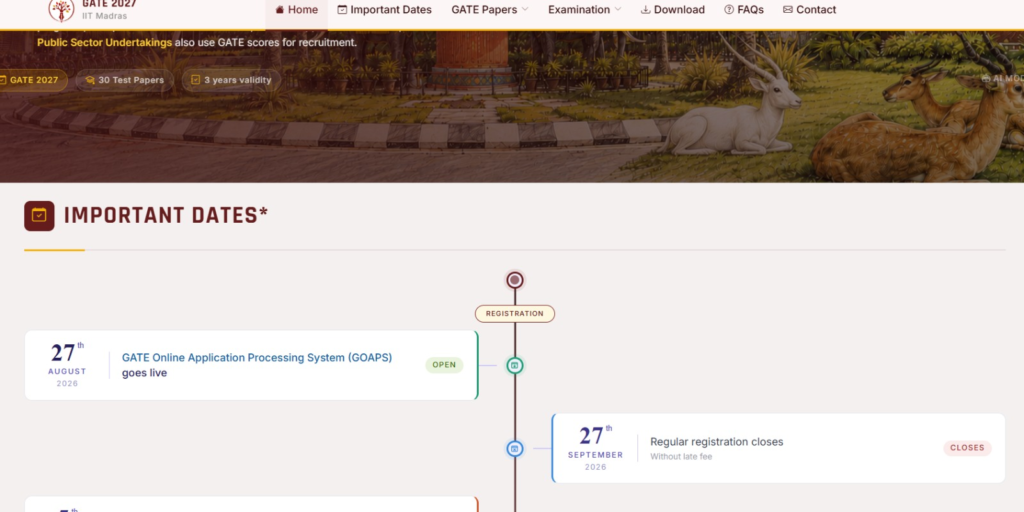
GATE 2027 Important Dates
| Event | Date |
|---|---|
| Registration Begins | 27-Aug-26 |
| Last Date Without Late Fee | 27-Sep-26 |
| Last Date With Late Fee | 5-Oct-26 |
| Admit Card | January 2027 (Expected) |
| Exam Dates | 6-7 February, 13-14 February & 20-21 February 2027 |
| Response Sheet | Feb-27 |
| Answer Key | Feb-27 |
| Result Declaration | 19-Mar-27 |
| Scorecard Download | Mar-27 |
What’s New in GATE 2027?
GATE 2027 introduces some important changes.
1. New Robotics Paper
A new subject paper named Robotics has been introduced. The paper is expected to attract students from:
- Mechanical Engineering
- Electronics Engineering
- Computer Science
- Artificial Intelligence
- Mechatronics
- Automation Engineering
The introduction reflects the increasing industry demand for robotics and automation professionals.
2. Revised Syllabus
Several existing papers have revised syllabi after nearly five years. Candidates should carefully download the latest syllabus before beginning preparation.
GATE 2027 Eligibility Criteria
Candidates must satisfy the following eligibility conditions.
Educational Qualification
Candidates who are:
- Currently studying in the 3rd year or higher of an undergraduate degree
- Completed an undergraduate degree
- Engineering graduates
- Technology graduates
- Architecture graduates
- Science graduates (eligible disciplines)
- Humanities graduates (for respective papers)
There is no minimum percentage requirement to appear for GATE.
Age Limit
There is no age limit for GATE 2027.
Candidates of any age meeting educational qualifications may apply.
Application Fee
| Category | Regular Period | Extended Period |
|---|---|---|
| Female/SC/ST/PwD* candidates (per test paper) | ₹1000 | ₹1500 |
| All other candidates including foreign nationals (per test paper) | ₹2000 | ₹2500 |
GATE 2027 Application Process
Candidates can submit applications online through the official GATE portal.
Step 1
Register using:
- Email ID
- Mobile Number
Step 2
Fill in personal details:
- Name
- Date of Birth
- Category
- Address
Step 3
Provide academic details.
Step 4
Select:
- Examination Paper
- Preferred Exam Cities
Step 5
Upload required documents.
Step 6
Pay the application fee.
Step 7
Submit and download the confirmation page.
Documents Required
Applicants should keep ready:
- Passport-size photograph
- Signature
- Category certificate (if applicable)
- PwD certificate
- Degree certificate or provisional certificate
- Valid identity proof
GATE 2027 Exam Pattern
The examination will be conducted in Computer-Based Test (CBT) mode.
| Particular | Details |
|---|---|
| Mode | Online |
| Duration | 3 Hours |
| Total Marks | 100 |
| Question Type | MCQs, MSQs, NAT |
| Medium | English |
Sections
Every paper generally consists of:
- General Aptitude
- Subject Questions
General Aptitude carries 15 marks, while subject-specific questions account for 85 marks.
Types of Questions
Multiple Choice Questions (MCQ)
- Four options
- One correct answer
- Negative marking applicable
Multiple Select Questions (MSQ)
- More than one correct option
- No negative marking
Numerical Answer Type (NAT)
- Numerical value to be entered
- No options
- No negative marking
Marking Scheme
Questions are generally of:
- 1 mark
- 2 marks
Negative marking applies only to MCQs.
GATE 2027 Papers
GATE offers examinations in multiple disciplines including:
- Aerospace Engineering
- Agricultural Engineering
- Architecture
- Biomedical Engineering
- Biotechnology
- Civil Engineering
- Chemical Engineering
- Computer Science and Information Technology
- Data Science and Artificial Intelligence
- Electronics and Communication Engineering
- Electrical Engineering
- Environmental Science
- Geomatics Engineering
- Humanities and Social Sciences
- Instrumentation Engineering
- Mathematics
- Mechanical Engineering
- Mining Engineering
- Metallurgical Engineering
- Naval Architecture
- Petroleum Engineering
- Physics
- Production and Industrial Engineering
- Statistics
- Textile Engineering
- Ecology and Evolution
- Life Sciences
- Robotics (New)
GATE 2027 Score Validity
The GATE score remains valid for three years from the date of result declaration.
Candidates can use the score for:
- M.Tech admissions
- PSU recruitment (where applicable)
- Research admissions
- Fellowships
Why is GATE Important?
A good GATE score opens several career opportunities.
Higher Education
Candidates can secure admission into:
- IITs
- IISc Bengaluru
- NITs
- IIITs
- Central Universities
- State Universities
PSU Recruitment
Many Public Sector Undertakings recruit candidates through GATE scores, such as:
- ONGC
- NTPC
- GAIL
- BPCL
- HPCL
- IOCL
- Power Grid Corporation
- NHPC
- BHEL
- NPCIL (subject to recruitment notifications)
Scholarships
Qualified students pursuing M.Tech receive AICTE-approved postgraduate scholarships, subject to prevailing government guidelines.
Preparation Tips for GATE 2027
Understand the Syllabus
Download the latest syllabus released by IIT Madras and focus on the updated topics.
Know the Exam Pattern
Understand the weightage of General Aptitude, Engineering Mathematics, and core subjects.
Make a Study Plan
Allocate time for:
- Concept building
- Practice questions
- Revision
- Mock tests
Solve Previous Year Papers
Previous years’ question papers help you understand:
- Difficulty level
- Important topics
- Time management
Take Mock Tests
Regular online mock tests improve:
- Speed
- Accuracy
- Confidence
GATE Two Papers Combinations
| Primary Paper Code | Eligible Secondary Paper Code(s) |
|---|---|
| AE (Aerospace Engineering) | CE, ME, XE |
| AG (Agricultural Engineering) | CE |
| AR (Architecture and Planning) | CE, GE |
| BM (Biomedical Engineering) | BT, IN |
| BT (Biotechnology) | BM, XL |
| CE (Civil Engineering) | AE, AG, AR, ES, GE, NM, XE |
| CH (Chemical Engineering) | ES, PE, XE |
| CS (Computer Science & Information Technology) | DA, EC, GE, MA, PH, RA, ST, ME |
| CY (Chemistry) | XE, XL |
| DA (Data Science & Artificial Intelligence) | CS, EC, EE, MA, ME, PH, RA, ST, XE |
| EC (Electronics & Communication Engineering) | CS, DA, EE, IN, PH |
| EE (Electrical Engineering) | DA, EC, IN, PH, RA |
| ES (Environmental Science & Engineering) | CE, CH, GE |
| EY (Ecology and Evolution) | XL |
| GE (Geomatics Engineering) | AR, CE, CS, ES, GG |
Additional Two-Paper Combinations
| Primary Paper Code | Eligible Secondary Paper Code(s) |
|---|---|
| GG (Geology and Geophysics) | GE |
| IN (Instrumentation Engineering) | BM, EC, EE, ME |
| MA (Mathematics) | CS, DA, PH, ST |
| ME (Mechanical Engineering) | AE, DA, IN, NM, PI, XE, RA, CS |
| MN (Mining Engineering) | Not Applicable (No secondary paper allowed) |
| MT (Metallurgical Engineering) | XE |
| NM (Naval Architecture and Marine Engineering) | CE, ME, XE |
| PE (Petroleum Engineering) | CH |
| PH (Physics) | CS, DA, EC, EE, MA, XE |
| PI (Production and Industrial Engineering) | ME, XE |
| RA (Robotics and Artificial Intelligence) | EE, ME, DA, CS |
| ST (Statistics) | CS, DA, MA, XH |
| XE (Engineering Sciences) | AE, CE, CH, CY, DA, ME, MT, NM, PH, PI |
| XH (Humanities and Social Sciences) | ST |
| XL (Life Sciences) | BT, CY, EY |
Frequently Asked Questions
1. Who is conducting GATE 2027?
IIT Madras is the organizing institute for GATE 2027 and will examine on behalf of the National Coordination Board (GATE).
2. When will GATE 2027 registration begin?
The online registration process for GATE 2027 will begin on 14 August 2026, but the registration date has been changed; the form will now open on 27 August 2026.
3. What is the last date to apply for GATE 2027?
Candidates can apply without a late fee until 27 September 2026. The application window with a late fee will remain open until 5 October 2026.
4. What are the GATE 2027 exam dates?
The GATE 2027 examination will be held on 6, 7, 13, 14, 20, and 21 February 2027 in multiple sessions.
5. What is the new paper introduced in GATE 2027?
GATE 2027 introduces Robotics and Artificial Intelligence (RA) as a new paper, reflecting the growing demand for robotics and AI professionals.
6. Has the GATE 2027 syllabus changed?
Yes. IIT Madras has revised the syllabus for several papers for the first time in nearly five years. Candidates should download the latest syllabus before starting their preparation.
7. Can I appear for two papers in GATE 2027?
Yes. Candidates may opt for up to two papers, provided the chosen paper combination is allowed as per the official two-paper combination list released by IIT Madras.