
World Elephant Day 2026: India Reaffirms Commitment to Elephant Conservation
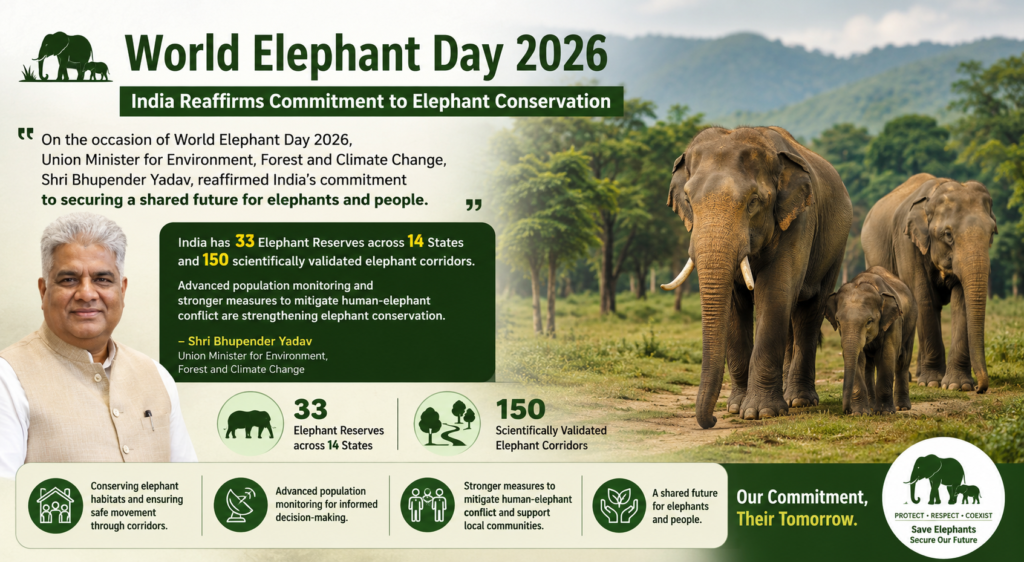
On the occasion of World Elephant Day 2026, Union Minister for Environment, Forest and Climate Change Shri Bhupender Yadav reaffirmed India’s commitment to ensuring a shared and sustainable future for elephants and people.
In a social media post, the Minister highlighted India’s ongoing efforts to strengthen elephant conservation and protect their habitats. India currently has 33 Elephant Reserves across 14 States and 150 scientifically validated elephant corridors, which play an important role in ensuring safe movement of elephants between habitats.
The Minister also noted that advanced elephant population monitoring and stronger conservation measures are being implemented to address the growing challenge of human-elephant conflict.
Protecting Elephants and Their Habitats
Elephants require large, connected habitats for food, water and seasonal movement. As human settlements and infrastructure expand, protecting wildlife corridors has become increasingly important.
India’s elephant conservation efforts therefore focus not only on protecting elephant reserves but also on maintaining and strengthening corridors that allow elephants to move safely across landscapes.
Focus on Reducing Human-Elephant Conflict
Human-elephant conflict remains one of the major challenges to elephant conservation. Improved population monitoring, scientific assessment and stronger measures can help authorities identify conflict-prone areas and take timely preventive action.
The government’s renewed emphasis reflects the need to balance wildlife conservation with the safety and livelihoods of local communities.
World Elephant Day 2026
World Elephant Day is observed every year on August 12 to raise awareness about elephant conservation and the threats faced by elephant populations around the world.
India’s 33 Elephant Reserves and 150 scientifically validated elephant corridors represent important conservation assets. Strengthening these protected areas and ensuring safe elephant movement will remain crucial for securing a future where both elephants and people can thrive together.