

Table of Contents
How you can crack the CLAT PG 2027. The first step is to know the CLAT PG previous year question paper of the exam. Interestingly the CLAT PG exam pattern and syllabus is from the topics you have studied in your last exam.
Preparing for the Common Law Admission Test for Postgraduate Programmes (CLAT PG) requires a well-planned strategy, consistent revision, and regular practice. Among all preparation resources, previous year question papers are one of the most valuable study materials. They help candidates understand the actual examination pattern, identify important topics, improve legal reasoning, and evaluate their level of preparation.
You should not miss the chance to solve the CLAT PG previous year question paper of your study plan. By practising official papers, you become familiar with the type of questions asked, the level of difficulty, and the time required to complete the examination. Recent CLAT PG question papers and answer keys are available through educational resources and official releases.
Why Are CLAT PG previous year question paper Important?
CLAT PG previous year question paper provide a realistic understanding of the examination. Since the questions are taken from actual CLAT PG exams, they reflect the style and standard of questions expected in future examinations.
Regular practice helps candidates:
• Understand the latest CLAT PG exam pattern 2027.
• Identify frequently tested legal topics.
• Improve speed and accuracy.
• Develop effective time-management skills.
• Build confidence before the examination.
• Assess strengths and weaknesses.
Rather than studying randomly, candidates can focus on topics that have consistently appeared in previous examinations.
Understanding the Exam Pattern Through CLAT PG previous year question paper
By analysing previous papers, candidates become familiar with the current exam structure.
The examination generally consists of:
• 120 multiple-choice questions.
• One mark for every correct answer.
• Negative marking of 0.25 marks for each incorrect answer.
• Duration of two hours.
• Questions based mainly on Constitutional Law and other core LL.B. subjects.
Practising actual papers allows candidates to experience the pressure of solving the complete paper within the allotted time.
Subjects Covered in Previous Year Papers
The questions are drawn from various law subjects studied during the LL.B. programme.
Major subjects include:
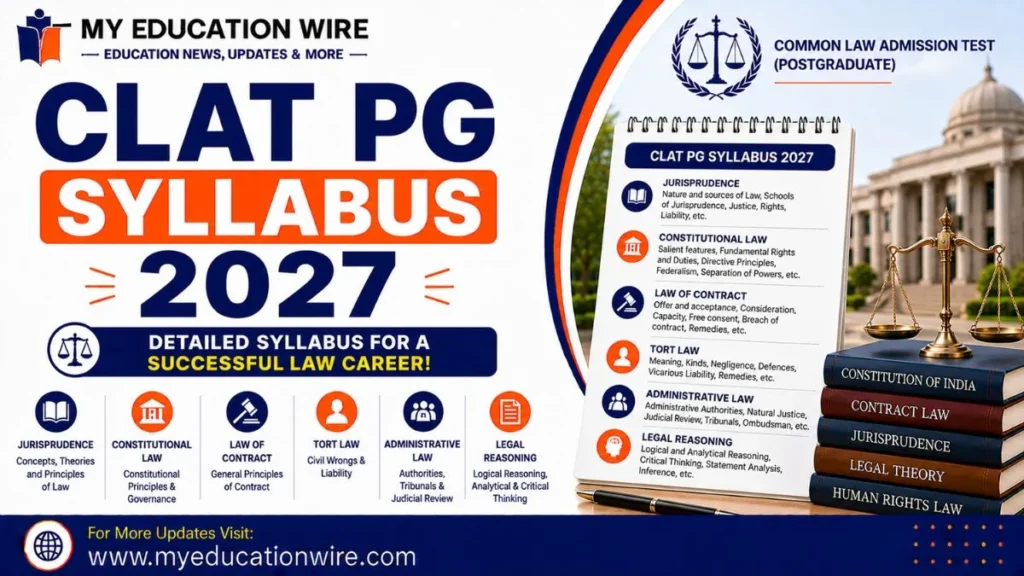
• Constitutional Law
• Jurisprudence
• Administrative Law
• Law of Contracts
• Law of Torts
• Criminal Law
• Family Law
• Property Law
• Company Law
• Public International Law
• Environmental Law
• Labour and Industrial Law
• Tax Law
Among these, Constitutional Law consistently carries significant weightage.
Why Solving CLAT PG previous year question paper Helps
Understand the Difficulty Level
Many candidates underestimate or overestimate the examination. CLAT PG previous year question paper provide a realistic picture of the level of questions.
Identify Important Topics
Certain constitutional provisions, legal doctrines, statutory provisions, and landmark judgments appear repeatedly. Identifying these areas helps candidates prioritize revision.
Improve Time Management
Since the examination is time-bound, practising complete papers under exam conditions helps candidates learn how much time to spend on each question.
Increase Accuracy
Repeated practice reduces careless mistakes and improves answer selection, which is particularly important because of negative marking.
Build Examination Confidence
Candidates who solve multiple previous papers generally feel more confident on exam day because they are already familiar with the examination format.
How to Use Previous Year Papers Effectively
Simply reading old papers is not enough. Candidates should follow a systematic approach.
Step 1: Complete the Syllabus
Finish studying the major subjects before attempting full-length previous papers.
Step 2: Solve Without Looking at Answers
Attempt each paper honestly under timed conditions. Avoid referring to books or notes during the test.
Step 3: Analyse Mistakes
After completing the paper:
• Check incorrect answers.
• Identify weak subjects.
• Revise the relevant Bare Acts.
• Understand why the correct option is right.
Step 4: Revise Important Topics
If multiple mistakes occur in a particular subject, spend additional time strengthening that area before attempting another paper.
Importance of Bare Acts While Solving Papers
Many questions in CLAT PG 2027 are directly based on statutory provisions.
Therefore, while analysing previous papers:
• Read the relevant Bare Act.
• Understand important definitions.
• Learn key sections.
• Revise exceptions and provisos.
• Connect statutory provisions with judicial decisions.
This approach helps improve conceptual clarity rather than memorizing answers.

Previous Papers and Landmark Judgments
Several questions are based on landmark Supreme Court decisions.
While reviewing previous papers, candidates should prepare:
• Facts of the case.
• Legal issue involved.
• Decision of the Court.
• Legal principle established.
Maintaining short notes for landmark judgments makes revision much easier before the examination.
Mock Tests vs Previous Year Papers
Both are important, but they serve different purposes.
Previous Year Papers | Mock Tests
Based on actual CLAT PG exams 2027 | Prepared by coaching institutes or educators
Reflect real question trends | Help with additional practice
Show actual exam difficulty | Improve speed and time management
Ideal for understanding the pattern | Useful for continuous assessment
A balanced preparation strategy includes both previous year papers and mock tests.
Common Mistakes to Avoid
Candidates should avoid the following mistakes while using CLAT PG previous year question paper:
• Memorising answers without understanding the concepts.
• Ignoring mistakes after completing the paper.
• Solving papers without a timer.
• Attempting too many papers without revision.
• Neglecting Bare Acts and landmark judgments.
• Focusing only on one subject.
The real benefit comes from analysing each paper carefully and revising weak topics.
Where to Download Previous Year Question Papers
Candidates should use reliable sources to access official CLAT PG papers and CLAT PG 2027 answer keys. Educational portals provide year-wise PDFs, and the Consortium also releases official papers and answer keys for recent examinations.
These resources include recent question papers along with answer keys that can be used for self-evaluation.
Expert Preparation Tips
To make the best use of CLAT PG previous year question paper:
• Begin solving papers after completing the basic CLAT PG 2027 syllabus.
• Attempt one paper every week initially.
• Increase the frequency during the final months before the examination.
• Maintain an error notebook to record frequently made mistakes.
• Revise Bare Acts after every practice session.
• Study landmark judgments related to incorrect answers.
• Focus on improving accuracy rather than attempting every question.
Consistency in practice is more beneficial than solving many papers in a short period.
CLAT PG 2027 Practice Questions (2026 Pattern)
Q1. Constitutional Law
A State Legislature enacts a law restricting public assemblies in designated areas to maintain public order. A citizen challenges the law, claiming it violates the right to assemble peacefully under Article 19(1)(b) of the Constitution.
Which of the following is the most appropriate legal principle?
A. Every restriction on assembly is unconstitutional.
B. The State may impose reasonable restrictions in the interest of public order.
C. Public assemblies can never be regulated by law.
D. Only Parliament can regulate public assemblies.
Answer: B
Q2. Law of Contract
X offers to sell his motorcycle to Y for ₹80,000. Before Y communicates acceptance, X revokes the offer.
Which statement is correct?
A. Revocation is invalid once the offer is made.
B. Revocation is valid if communicated before acceptance is complete against the proposer.
C. Revocation is never permitted.
D. Acceptance automatically occurs after a reasonable time.
Answer: B
Q3. Criminal Law
A person intentionally strikes another with a heavy iron rod, causing serious injuries that later result in death.
Which factor is most relevant in determining criminal liability?
A. The victim’s occupation.
B. The accused’s intention or knowledge at the time of the act.
C. The place where the incident occurred.
D. The accused’s educational qualification.
Answer: B
Q4. Administrative Law
A government authority cancels a business licence without giving the licence holder an opportunity to explain.
Which principle has most likely been violated?
A. Res judicata
B. Audi alteram partem (right to be heard)
C. Doctrine of Eclipse
D. Rule against delegation
Answer: B
Q5. Jurisprudence
According to the theory of legal positivism:
A. Law derives its validity from morality alone.
B. Law and morality are always identical.
C. Law is valid because it is created by a recognized legal authority.
D. Only customary rules constitute law.
Answer: C
Q6. Environmental Law
An industrial unit releases untreated waste into a nearby river, causing significant environmental damage.
Which environmental principle is most applicable?
A. Doctrine of Severability
B. Polluter Pays Principle
C. Basic Structure Doctrine
D. Doctrine of Waiver
Answer: B
Q7. Company Law
Which of the following best describes the doctrine of separate legal personality?
A. Directors and the company are the same legal entity.
B. A company has an independent legal identity separate from its shareholders.
C. Shareholders are personally liable for all company debts.
D. A company cannot own property.
Answer: B
Q8. Public International Law
Which principle prohibits one State from intervening in the internal affairs of another sovereign State?
A. Pacta Sunt Servanda
B. State Succession
C. Principle of Non-Intervention
D. Universal Jurisdiction
Answer: C

In The End
CLAT PG previous year question paper are among the most effective resources for CLAT PG 2027 preparation. They provide valuable insight into the exam pattern, question trends, subject weightage, and difficulty level while helping candidates improve speed, accuracy, and confidence. However, solving papers alone is not enough. Candidates should carefully analyse every attempt, revise the relevant Bare Acts, study important judgments, and work on weak areas identified through practice. Combined with regular revision, mock tests, and conceptual learning, previous year question papers can significantly improve performance and increase the chances of securing admission to a top National Law University.
FAQs
Q1. How are previous year paper a help in CLAT PG ?
It tells you how the questions are asked in the exam thus giving you clear picture
Q2. How can I get the previous year papers?
There are many online resources available myeducationwire.com is one of them you can find the previous year papers there
Q3. What is the syllabus for CLAT PG 2027 ?
The syllabus is what you have studied in your last qualifying exam
Q4. What is the good rank for NLU LLM admission?
You rank under 1000 is a good rank for admission in NLU. If you are aiming for better NLU then this rank is around 1 to 300